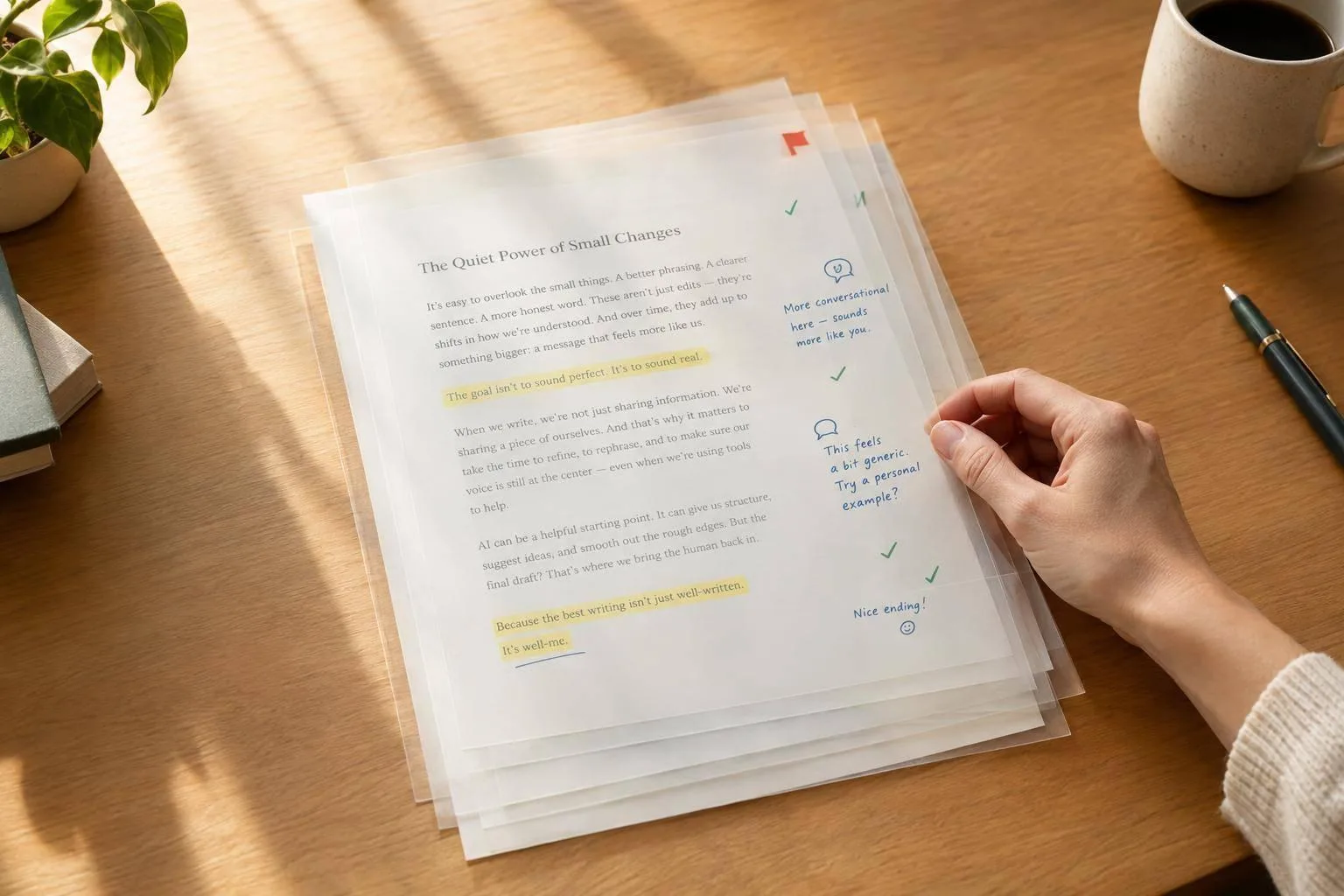
If an AI draft doesn’t sound like me, I fix the edits - not rewrite the whole piece. I compare it with my original and a past writing sample, then check 3 things: meaning, voice, and grammar.
Here’s my review process:
- Protect my position. I check that “could” hasn’t become “will,” caveats remain, and opinions still belong to the right person.
- Restore my wording. I replace phrases I wouldn’t use and read aloud to check the rhythm.
- Keep edits small. I give AI clear limits, review changes one at a time, and check names, numbers, and claims.
“Keep my voice” isn’t enough. I spell out what must stay: my tone, boundaries, and level of certainty. A side-by-side tool such as UnslopAI can help me review changes, but I make the final call.
The Storytelling AI Method That Keeps Your Voice
Why AI Edits Change Your Voice
Your voice can drift when AI edits for smoothness rather than keeping the writing yours.
Informal words become formal. Abrupt lines get transitions. Strong emotion turns neutral. These edits may make a draft read more smoothly, but they can also erase the choices that make it sound like you.
Smoother Wording Can Change Your Position
Consider a hypothetical founder email:
Original: I’m not ready to promise that
Polished: We remain optimistic about future possibilities
The original sets a personal boundary: the founder isn't making a promise. The rewrite swaps that boundary for shared optimism, changing what you're willing to stand behind. That's a change in commitment, not just style.
Once you spot how a rewrite changes your stance, you can make the prompt more specific.
Voice-Preservation Prompts Need Review
A prompt like keep my voice doesn't tell AI what to preserve. Give it a narrower instruction:
Preserve boundaries, caveats, and tone; do not add confidence or enthusiasm.
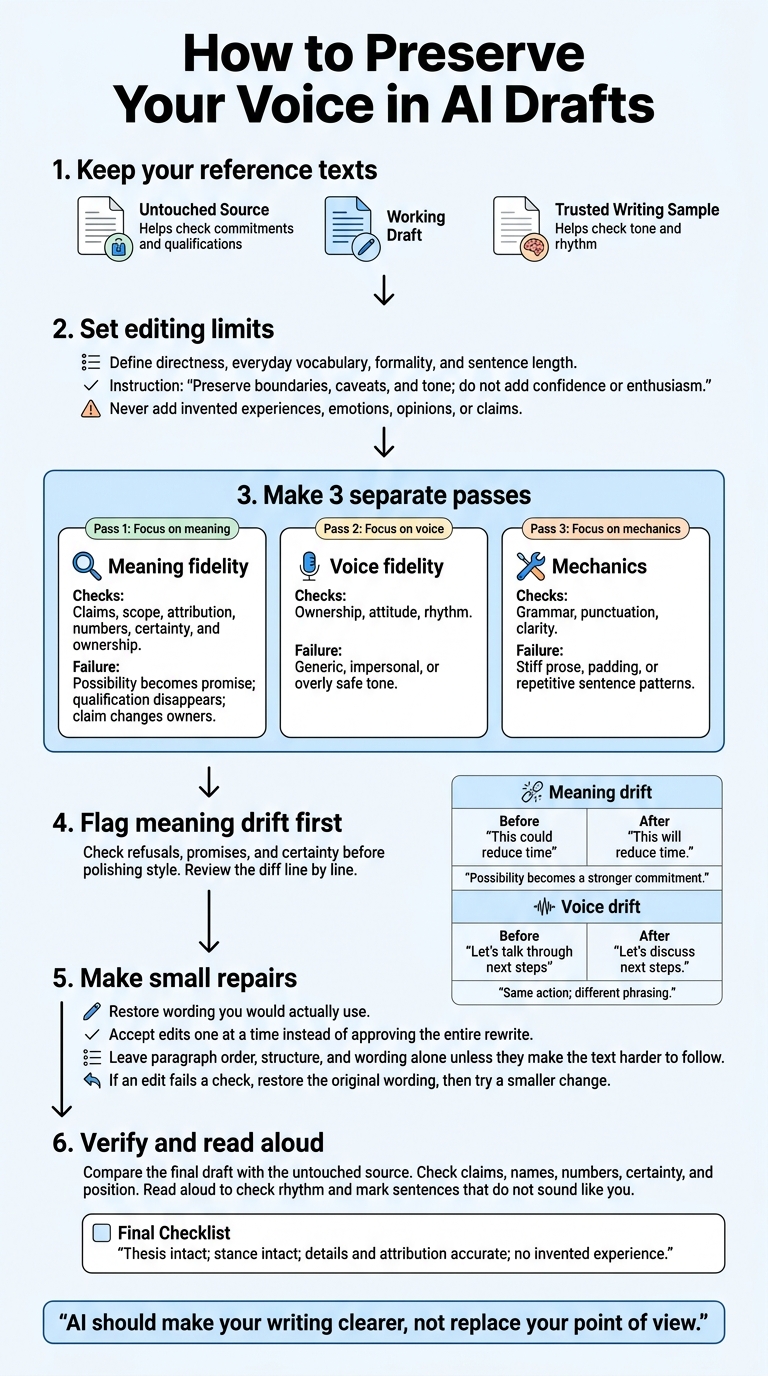
Compare the result with both the source and a short writing sample you trust. The source helps you check commitments and qualifications. The sample helps you check tone and rhythm.
Check refusals, promises, and certainty first. Flag edits that change any of these before polishing the rest.
Then review the diff line by line to catch shifts in meaning before editing for style.
Spot Changes to Meaning and Voice
Use the diff to sort each change into meaning, voice, or mechanics. Check whether the draft still expresses your view, including your qualifications and personal judgments. Look for changes in ownership, not just smoother writing.
Check Meaning, Voice, and Grammar Separately
Make three separate passes. A sentence can be grammatically correct and still misstate your position. It can also be accurate without sounding like you.
| Measure | What it checks | What failure looks like |
|---|---|---|
| Meaning fidelity | Claims, scope, attribution, numbers, certainty, and ownership | Possibility becomes promise; qualification disappears; claim changes owners |
| Voice fidelity | Ownership, attitude, rhythm | Generic, impersonal, or overly safe tone |
| Mechanics | Grammar, punctuation, clarity | Stiff prose, padding, or repetitive sentence patterns |
For first-person statements, check who holds the opinion and how strongly they feel about it. Read the passage aloud to check rhythm. You can also spot the AI by testing your detection skills against human writing. If merged sentences shift the emphasis or pacing, flag them. Unfamiliar wording should make the point clearer, not just sound different.
Flag Stronger Claims and Unfamiliar Phrasing
After those separate checks, label each shift by type. Flag meaning drift first:
This could reduce time → This will reduce time.
Keep the original level of certainty unless you have evidence and intend to make the stronger claim.
Then flag voice drift:
Let’s talk through next steps → Let’s discuss next steps.
The action hasn’t changed, but the phrasing may no longer sound like you. Put back the words you would actually use. The first change alters commitment; the second alters voice.
Restore Your Voice With Small Edits
When you spot drift, edit the draft rather than regenerate the whole piece. Keep an untouched source alongside your working draft, and make changes in that draft - not a new version. Fix only what needs fixing. Leave paragraph order, structure, and wording alone unless they make the text harder to follow.
Set Your Voice Profile and Editing Limits
Create a reusable editing brief that sets your directness, everyday vocabulary, formality, and sentence length. Let it guide edits and protect your voice. Cut generic transitions and inflated language, but never add invented experiences, emotions, opinions, or claims. Change the rhythm only when it fits your profile - not just for variety.
Review Diffs and Check Meaning
Review each change, then compare the final draft with the untouched source. Check claims, names, numbers, certainty, and position closely. Accept edits one at a time instead of approving the entire rewrite.
Use this final checklist: Thesis intact; stance intact; details and attribution accurate; no invented experience. If an edit fails any check, restore the original wording, then try a smaller change.
Use UnslopAI to Rewrite and Review Changes
To speed up the review, use a tool that displays edits side by side. UnslopAI rewrites polished drafts, shows before-and-after diffs, and checks names, numbers, and claims.[1][2] Let the automated checks flag problems, then decide for yourself whether to keep or reject each edit.
Conclusion: Check Meaning and Voice Before Publishing
Before publishing, compare the draft with your source, review the diff, and make one last check that the meaning hasn’t changed. Then read it aloud and mark any sentence that doesn’t sound like you.
If a line still feels off, bring back your original wording. Keep your judgment, confidence, and reservations intact.
AI should make your writing clearer, not replace your point of view. The draft is ready when it says what you mean in words you’d use.
FAQs
How do I choose a writing sample that reflects my voice?
Start with something you’ve written: an email, LinkedIn post, newsletter intro, or blog paragraph. Match the reference to the draft’s length. Emails and LinkedIn posts work well for shorter drafts; newsletter intros and blog excerpts suit longer ones.
Look at how you build sentences, which words you choose, and the tone and rhythm of your writing. Use those patterns to guide AI-generated drafts so they sound more like you.
What if my original wording is unclear?
Use plain, direct language instead of AI-generated polish that can blur your point. Cut filler and swap complex words for simpler ones you’d use in conversation.
Once your draft is clear, use UnslopAI to refine its rhythm and structure. It removes robotic patterns and runs fidelity checks to help keep your specific claims, names, and numbers intact and accurate.
How can I adapt my tone without losing my voice?
Treat AI as a draft partner, not the final writer. Use your past emails or newsletters as a guide to your rhythm and word choice.
UnslopAI helps remove robotic patterns and stiff, over-polished filler without changing your meaning. Its before-and-after diffs, slop scoring, and fidelity checks help you polish your prose, keep claims and numbers accurate, and stay true to your perspective.