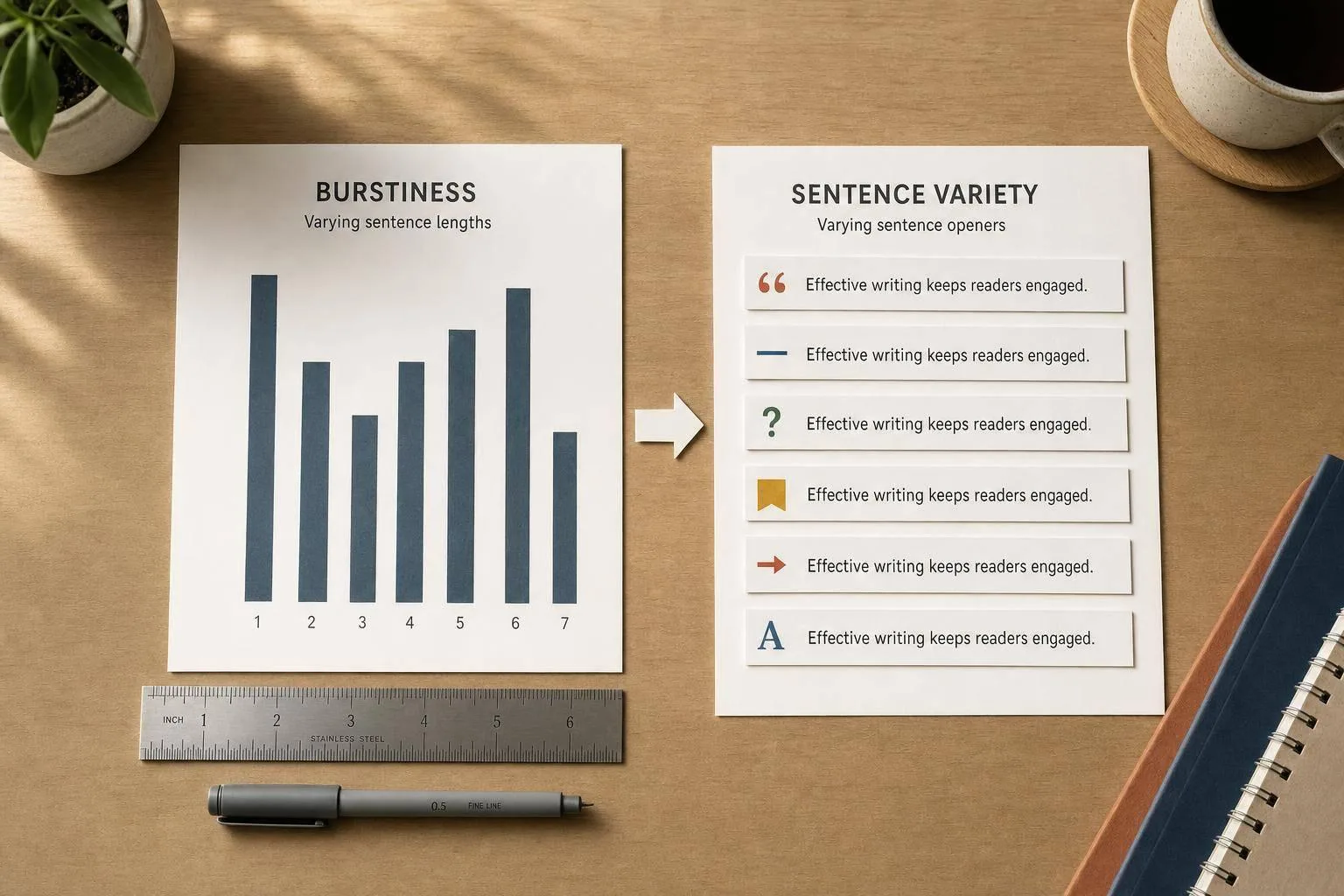
Here’s the short answer: burstiness and sentence variety are not the same thing. Burstiness checks how much sentence length and complexity change. Sentence variety checks the mix of openings, structure, rhythm, and flow. If you want to review AI-style text, I’d use burstiness to spot a flat passage first, then use sentence variety to decide what to change.
A draft can have high burstiness and still sound repetitive. That happens when sentence lengths change, but the writer keeps using the same openings, clause order, or wrap-up lines. On the other hand, low burstiness does not prove AI use. Legal, technical, and how-to writing often keeps a tighter rhythm on purpose.
Here’s what I’d keep in mind right away:
- Burstiness = a number-based signal
- Sentence variety = an editing check
- Both can point to flat rhythm
- Neither one can confirm authorship
- Neither one checks facts, names, or numbers
- Best workflow: measure first, edit next, then verify details
How to Humanize AI Content with Burstiness
Quick Comparison
| Criteria | Burstiness | Sentence Variety |
|---|---|---|
| What it looks at | Sentence length and complexity shifts | Openings, syntax, form, and rhythm |
| Type | Measured signal | Editorial review |
| Main question | How much do sentences vary? | How do sentences vary, and does it sound natural? |
| Best use | First-pass screen | Rewrite and voice review |
| Main limit | Scores can shift from lists, headings, or punctuation | Hard to reduce to one score |
One more point matters: style signals are not truth checks. Even if a rewrite sounds better, I’d still review every change for names, claims, and numbers before calling it done.
Burstiness vs Sentence Variety: Definitions and Core Differences
Burstiness: How Much Sentence Length and Complexity Vary
Burstiness measures how uneven sentence length and sentence structure are across a draft.
Editors often gauge it with sentence-length spread, such as standard deviation or coefficient of variation. The bigger the spread, the higher the burstiness. In rewrite review, it serves as a quick signal of mechanical pacing at the sentence level.
That said, the metric has limits. Lists and heavy punctuation can skew the score. So while burstiness helps flag drafts that feel too even, it doesn't tell you much about style on its own.
Sentence Variety: Mixing Form, Openings, Syntax, and Rhythm
Sentence variety looks at the range of sentence forms in a draft.
It covers openings, syntax, rhythm, and the way sentences carry ideas forward. During revision, it helps show where to change openings, clause patterns, and pace. A draft may shift in length from sentence to sentence and still lean on the same opening or the same clause shape again and again.
That bigger lens matters. Sometimes the length pattern looks fine, but the prose still feels repetitive.
Comparison Table: Scope, Inputs, Outputs, and Editorial Use
| Feature | Burstiness | Sentence Variety |
|---|---|---|
| Scope | Quantitative - statistical distribution of sentence lengths | Qualitative - holistic pattern of structure, rhythm, and style |
| Primary Inputs | Sentence lengths, punctuation density, standard deviation | Sentence openings, syntax, rhythm, and how sentences carry ideas forward |
| Typical Calculation | Standard deviation or coefficient of variation | Editorial judgment or pattern detection |
| Key Question | How much variation exists? | What kind of variation exists, and does it help the reader? |
| Editorial Purpose | Flags unusually even or overly uniform prose | Guides revision of voice and rhythm |
| Limitations | Lists and formatting can skew the score | Harder to quantify with a single universal score |
Even when the numbers shift, the same writing can still feel flat for other reasons.
Where They Overlap and Where They Mislead
What Both Metrics Can Reveal in Flat AI-Assisted Prose
Once you know what each metric measures, the next step is seeing when they line up and when they send you off course. When a draft feels polished but lifeless, both metrics will often back up what your gut is already telling you: the cadence is too even.
They spot the same flatness from two different angles. That shared signal is useful. But it doesn't make the edit for you.
Cases Where the Numbers Can Point You in the Wrong Direction
The trouble starts when you treat either metric like a final verdict. Some AI writing tools can push up burstiness by forcing sentence-length swings. On paper, that looks like more variation. But the usual patterns often stay put: predictable paragraph structure, summary sentences, and formulaic transitions.
Low burstiness doesn't prove AI use either. Legal, technical, and instructional writing can land in the same range because clear writing often squeezes out variation. Formatting can skew the numbers too. Bullet lists and headings may shift scores in ways that have nothing to do with voice or rhythm.
Use the scores as a flag, then look at the draft itself. Check the openings, transitions, and paragraph endings. That's why burstiness works best as a screen for uneven rhythm, while sentence variety tells you what to revise.
Which Metric Helps More in AI Rewrite Checks
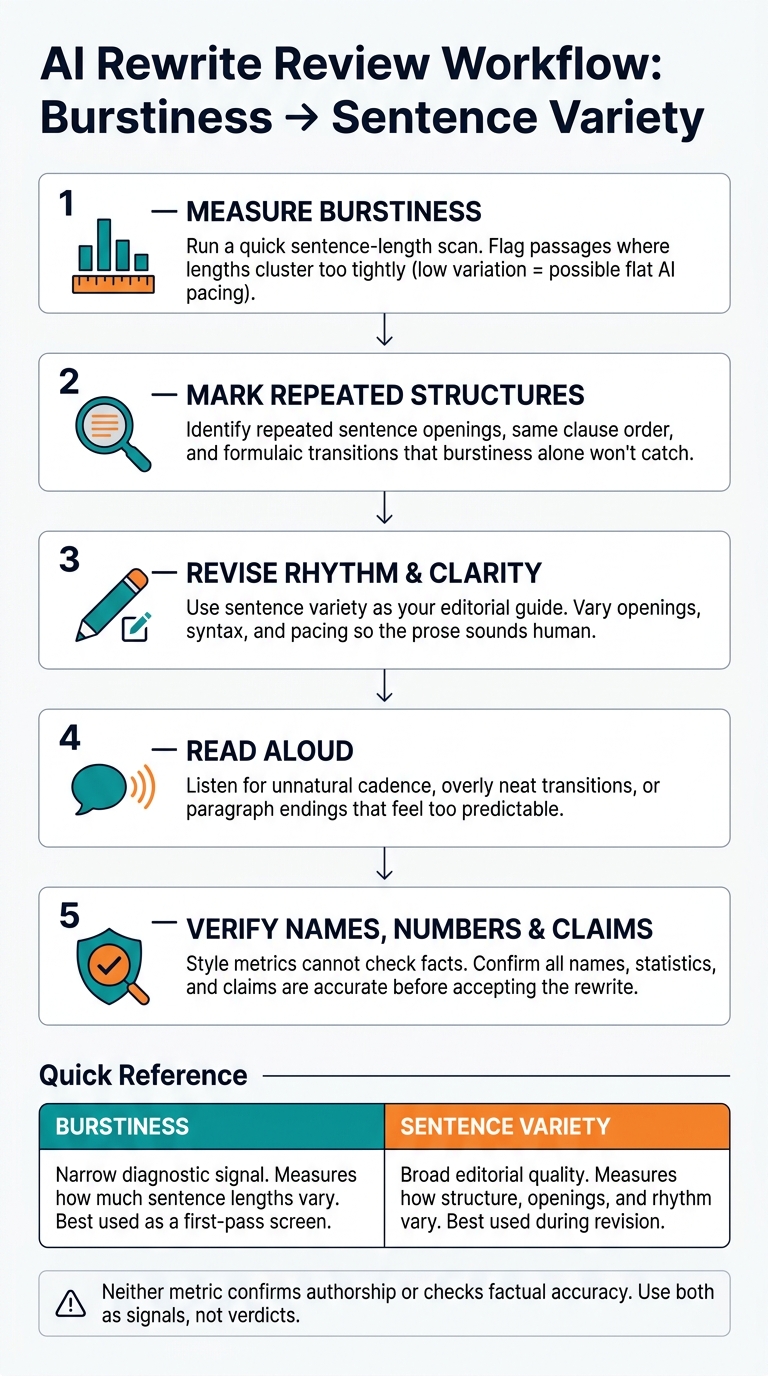
Neither metric wins on its own. Each does a different job, and they make more sense when you use them one after the other. Start with burstiness for a first scan. You can also automate this check using our API reference for custom workflows. Then use sentence variety during the edit.
Use Burstiness First to Flag Unusually Even Sentence Patterns
Burstiness comes first because it’s quick. A fast look at sentence length can show whether the writing feels too even from line to line. But don’t treat any fixed cutoff as a rule for every piece. Different document types and different ways of measuring can lead to different scores. So use burstiness to spot passages that may need a closer look, not to make the final call.
Use Sentence Variety Next to Decide What to Revise
Once burstiness points to a flat section, sentence variety helps you figure out what to fix. That’s where the editing starts in earnest. Check for repeated sentence openings, the same clause order showing up again and again, and transitions that feel a little too neat.
A simple workflow looks like this:
- Measure burstiness
- Mark repeated structures
- Revise rhythm and clarity
- Read the draft aloud
- Verify names, numbers, and claims
That last step matters. No style metric can tell you whether the facts are right. So these metrics help with revision, not just detection.
Comparison Table: Which Metric Fits Each Rewrite Task
The table below keeps diagnosis and revision separate.
| Task | More Useful Metric | Reason | Recommended Action |
|---|---|---|---|
| First-pass diagnosis | Burstiness | Quickly flags unusually even sentence lengths | Check if lengths cluster too tightly across the passage |
| Structural review | Sentence Variety | Identifies repeated openings and rhythm patterns | Mark repeated structures and revise patterns that weaken clarity |
| Final voice review | Sentence Variety | Ensures natural pacing and human rhythm | Read aloud and confirm transitions feel natural |
Applying This Framework with UnslopAI and Final Takeaways
How UnslopAI Supports Rewrite Review Without Reducing Quality to One Score
After you flag a draft, use UnslopAI to check whether the rewrite actually improved rhythm and structure. That shifts the metric comparison from theory into a hands-on editing check.
The slop score flags overly uniform prose. That pattern often overlaps with low burstiness. But it works best as a workflow flag, not as a second burstiness metric.
Once the score flags a passage, the diff shows what changed. The before-and-after diff view lets you inspect sentence-level edits directly. You can spot whether the rewrite changed repetitive transitions, rhythm, and the overall feel.
Fidelity checks make sure names, numbers, and claims stayed intact through the edit. Better style doesn't help much if a rewrite quietly drops a key detail.
Conclusion: Measure Variation, Then Edit for Voice and Clarity
With that workflow in place, the difference stays clear. Burstiness is a narrow diagnostic signal. It tells you whether sentence lengths cluster too tightly. Sentence variety is a broader editorial quality. It tells you whether structure, openings, and rhythm feel human.
The two overlap. Flat burstiness often points to weak sentence variety too. But they aren't the same thing. Burstiness helps you spot the issue; sentence variety helps you fix it. In final edits, sentence variety usually matters more, because that's where voice shows up.
Use metrics as signals, check every change in the diff, and confirm fidelity before you accept a rewrite. A high slop score or low burstiness reading isn't a final judgment - it's a cue to take a closer look.
That instinct is real. These metrics just give it a name.
FAQs
Can strong sentence variety still hide AI-style writing?
Yes. Strong sentence variety can make writing feel more human. But by itself, it often doesn't fix the deeper patterns that make text sound AI-made.
A piece can still feel too smooth, too neat, and too predictable. You’ll often see the same paragraph rhythm, the same kinds of transitions, and the same tidy wrap-up lines. That’s the giveaway.
So while changing sentence length helps, it usually isn’t enough on its own.
What makes burstiness scores misleading?
Burstiness scores can be misleading when a piece no longer lines up with the human baseline the metric expects. Prompts or outside rules can change sentence length and rhythm, but that shift doesn't reliably tell you who wrote it.
In cases like that, burstiness says more about formatting constraints - such as shorter, punchier sentences - than whether the writing feels AI-polished or human-like.
How do I audit a passage after checking burstiness?
After you check burstiness, look for any machine-like patterns still hiding in the passage. That usually means repeated sentence shapes, flat rhythm, or wording that feels a bit too polished in the same way over and over.
Then run a targeted pass with UnslopAI to bring back a more human cadence and stronger word choice, while keeping the meaning the same.
Use the slop score and the before-and-after diffs to verify the edit did its job. The goal is simple: reduce robotic patterns without drifting away from your original voice.