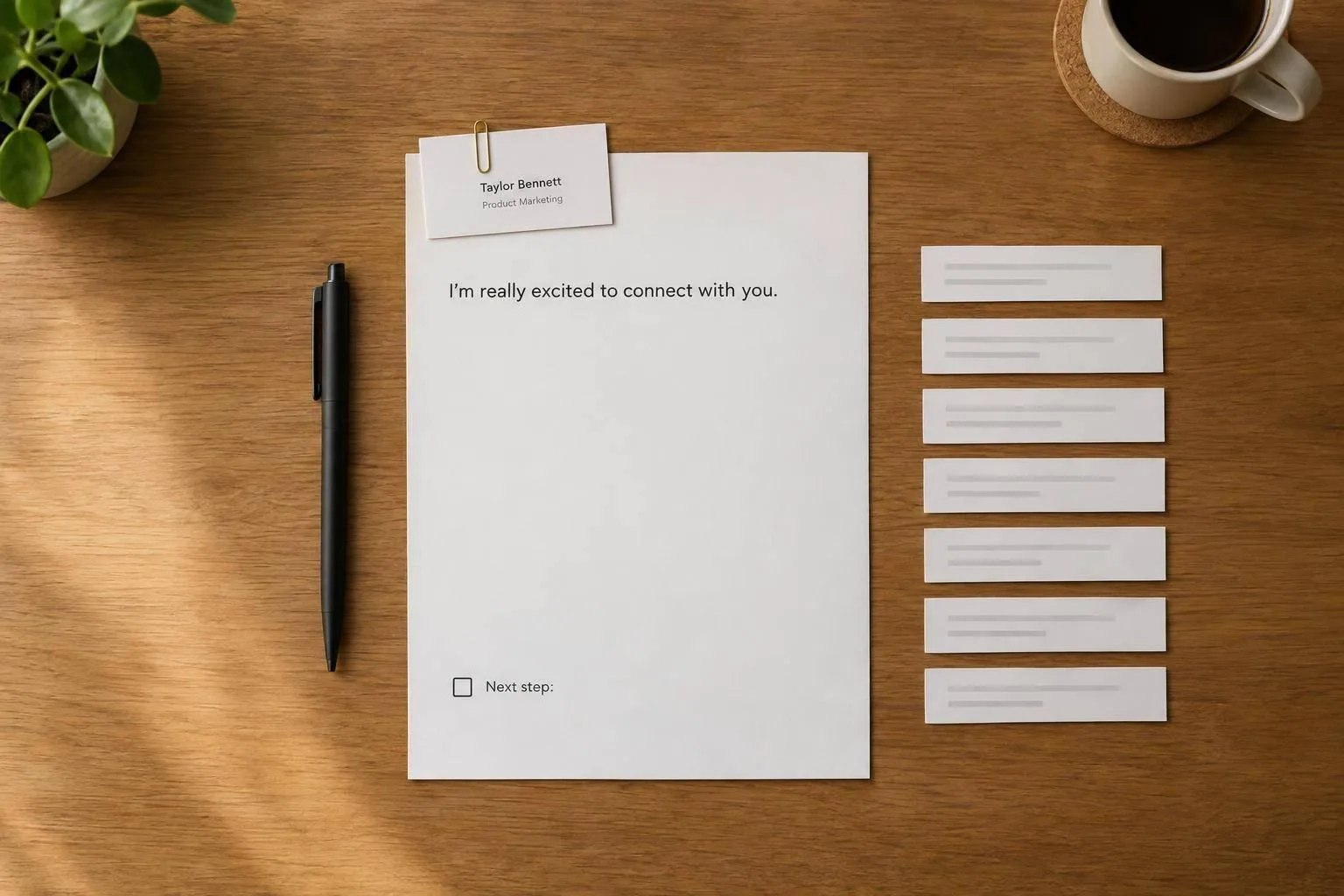
I use three checks for intro emails: who I am, why I chose this person, and one clear request. If I’m asking for a call, I name the topic and suggest 15–20 minutes.
These seven phrases often get in the way: (If you're unsure if your draft sounds robotic, spot the AI in our quiz.)
- “I’ve been following your impressive work” → I name a specific detail I’ve read.
- “I wanted to reach out” → I state why I’m writing.
- “That being said” and “in today’s landscape” → I skip the setup and give the facts.
- “Allow me to provide some context” → I introduce myself in one sentence.
- “Add value to your organization” → I explain what I can offer, without unsupported claims.
- “I’d love to pick your brain” → I ask a focused question or propose a short call.
- “Thank you in advance for your time and consideration” → I use a brief thank-you and sign-off.
My rule: cut the filler, not the courtesy. I check that each detail is true, keep one next step, and put any deadline in the request - not the closing.
Why Your AI-Written Cold Emails Sound Like Everyone Else's
3 Things Every Intro Email Needs
Use these three checks to shape your email before polishing the wording.
Who you are: Give your name, role, organization, and one detail that connects you to the request. Stick to your role or a shared connection - not your career history.
Why this person: Point to a specific article, project, announcement, or shared interest that prompted you to write. Connect it to your purpose within the first two sentences.
One next step: Ask the reader to answer a question, review one item, make an introduction, or schedule a call. Choose ONE action rather than stacking requests.
For a meeting, name the topic and time, such as 20 minutes.
When judging the phrases below, match your tone to the relationship: warmer with mutual contacts, more formal for first-time outreach. Cut any sentence that doesn’t explain who you are, why you wrote, or what happens next.
1. “I’ve Been Following Your Impressive Work”
“Impressive work” is generic praise. AI drafts often use flattery without anything to back it up. And “I’ve been following” can sound insincere if you just found the person.
Cut praise you can’t support.
I’ve been following your impressive work and would love to connect
Name the connection instead:
Your article on customer interviews relates closely to the research I’m conducting.
This version explains how the person’s article connects to your email. To make it more specific, mention the exact detail that relates to your research - but only if you actually read it.
If you haven’t followed their work, explain how you found them or leave that claim out. Check the original source before offering praise, and stick to what’s true.
2. “I Wanted to Reach Out”
“I wanted to reach out” introduces the email but doesn’t explain why you’re writing. It leaves the reader guessing. State your reason in the first sentence.[1][2]
I’m writing because I’m looking for a design partner for our upcoming mobile app.
Include your role only if it helps explain the ask. Then make one clear request: ask whether they’re accepting app design projects or open to a short call.[1][3]
Padded transitions create the same problem.
3. “That Being Said” and “In Today’s Landscape”
An intro email should explain why you’re writing in the first sentence. Skip weak pivots like “that being said” and filler like “in today’s landscape.”
Here’s the difference.
Before:
That being said, in today’s rapidly changing business landscape, organizations are constantly adapting to new challenges. I thought it would be helpful to connect to explore how we might support your goals.
After:
I’m contacting you about the onboarding changes your team announced last month.
Try the cut-the-setup test: Remove the opening transition and reread the email. If you haven’t lost any useful information, leave it out. Keep announcements, project details, and dates.
4. “Allow Me to Provide Some Context”
If the reader doesn’t know you, add one line about who you are. “Allow me to provide some context” promises an explanation but makes the reader wait for it. Vague descriptions of your background and current work take up space without saying what you do.
Make that line count: identify yourself right away.
Before:
Allow me to provide some context regarding my professional journey and current area of focus.
After:
I’m Maya, a product researcher studying how small businesses adopt payment tools.
Include your name, role, and relevant work in one sentence. Stick to the background that explains your ask - not your full career history. Give the reader enough to place you, then move on.
5. “Add Value to Your Organization”
“Add value to your organization” leaves readers guessing. Does that mean cutting costs, improving retention, or something else? Spell out how you can help, then tie that offer to your request. In an intro email, the value you offer should support the ask - not take its place.
Make an offer the reader can check:
I can share the retention analysis we used to identify the main churn drivers.
Before citing a metric, check the baseline, time frame, audience, and your role. If you can’t verify those details, describe the method instead.
6. “I’d Love to Pick Your Brain”
This phrase sounds friendly, but it leaves the reader guessing. Do you want advice, an introduction, or a job lead? Name the ask instead.
Cut:
I’d love to pick your brain and learn more about your experience whenever you have availability
Use:
Would you be open to a 15-minute call next week to discuss your transition into product leadership?
The revised version is short, specific, and easy to answer. It gives the reader one clear next step, with a time commitment that fits Portland State University’s recommended 15–20 minutes for an informational interview.[4] Keep the conversation focused on advice - not a job or internship request.[5]
7. “Thank You in Advance for Your Time and Consideration”
This closing piles on courtesy phrases and can sound generic, overly formal, or presumptive. Adding “at your earliest convenience” adds pressure without saying what response you need or when you need it.
Use a brief thank-you and a standard sign-off:
Thanks for considering it. Best, Maya.
This shows appreciation without assuming the recipient will say yes. There’s no need to repeat your request or make another appeal for a response.
In a first-contact email, “in advance” can suggest the recipient has already agreed to help. If timing matters, include the deadline in your request. Otherwise, cut “at your earliest convenience” entirely.
Use the quick reference below for simple swaps.
Quick Reference: 7 Phrase Replacements
These swaps help your email sound human and make the ask easier to spot. Use the table to replace filler with clear, direct wording.
| Phrase to Cut | Why it fails | Better swap |
|---|---|---|
| “I’ve been following your impressive work” | Offers generic praise without evidence. | Point to a specific detail: Name the project, result, or detail that prompted your email. |
| “I wanted to reach out” | Announces the email instead of its purpose. | State the ask upfront: Explain why you’re writing in the first two lines. |
| Broad framing | Sets the scene without useful detail. | Use a specific lead-in: Start with the problem or data point that prompted your email. |
| “Allow me to provide some context” | Delays the background. | Introduce yourself in one line: Share only the background readers need to understand your request. |
| “Add value to your organization” | Promises a benefit without saying what it is. | Name the benefit: Explain what you can do and the result it could support. |
| “I’d love to pick your brain” | Leaves the request and time commitment unclear. | Make a time-bound ask: State the question or next step and how much time it involves. |
| “Thank you in advance for your time and consideration” | Makes the closing too long. | Keep the closing brief: End with a short thank-you and sign-off. |
Edit the idea, not just the wording. Cut any phrase that serves no purpose.
Next, use the checklist to trim any filler left in your draft.
Intro Email Editing Checklist
Before polishing the wording, check for gaps that make your email sound generic.
- Who you are and why you’re writing: Can the recipient understand your role and request in one read?
- Specificity and relevance: Does each personalized detail come from a real source - and matter to this recipient?
- Vague phrasing and unsupported claims: Remove empty transitions and claims about results you haven’t verified.
- One clear request: Keep one request. Cut any second ask.
If the email still feels vague, your request is still too broad.
For an optional final pass, UnslopAI can suggest edits that preserve your meaning and flag weak wording. Review every change before sending.
Conclusion: State Your Purpose and Make 1 Clear Request
After removing AI-sounding phrases, make one last pass: replace generic praise with a specific detail that explains why you’re contacting this person. Drop the padded setup, limit background to one or two sentences, and support claims about what you can contribute with experience or a verified result.
Introduce yourself briefly and make one request. Name the topic and how much time you’re asking for. Trim the ask and closing - not the courtesy - and give the recipient enough information to respond quickly.
FAQs
How can I sound direct without sounding rude?
Put your main point first. Cut filler such as “It’s important to note” and vague phrases like “Whether you’re a beginner or an expert.” Replace empty praise with specific, supported details and clear next steps:
“Thanks for using X. Contact support if you have questions.”
State your position directly without changing how certain it is. Keep “could” rather than turning it into “will.”
How do I personalize an email to someone I don’t know?
Cut generic openings and phrases that could fit anyone. State why you’re writing near the top. Write in first person, using your own voice, without changing your boundaries or how certain you sound. Replace vague compliments with a specific reference, date, or request.
Compare the draft with your original in separate passes. First, check meaning and claims. Then review voice and rhythm. Finally, check grammar and punctuation.
Should I avoid these phrases in follow-up emails too?
The same AI-sounding phrases crop up in follow-up emails: generic wording, filler transitions, vague conclusions, and paragraph endings that repeat the opening.
Put your purpose or ask near the top. Cut stock openers (“It’s important to note that”) and formulaic endings (“In conclusion”). Swap vague compliments for concrete details or a clear next step.