
Useful emphasis tells readers what matters - and why. Empty emphasis just calls something “important.” Replace vague praise with checked facts, name the risk or difference, and state the next step. A deadline such as 5 p.m. ET gives readers more direction than “act immediately.”
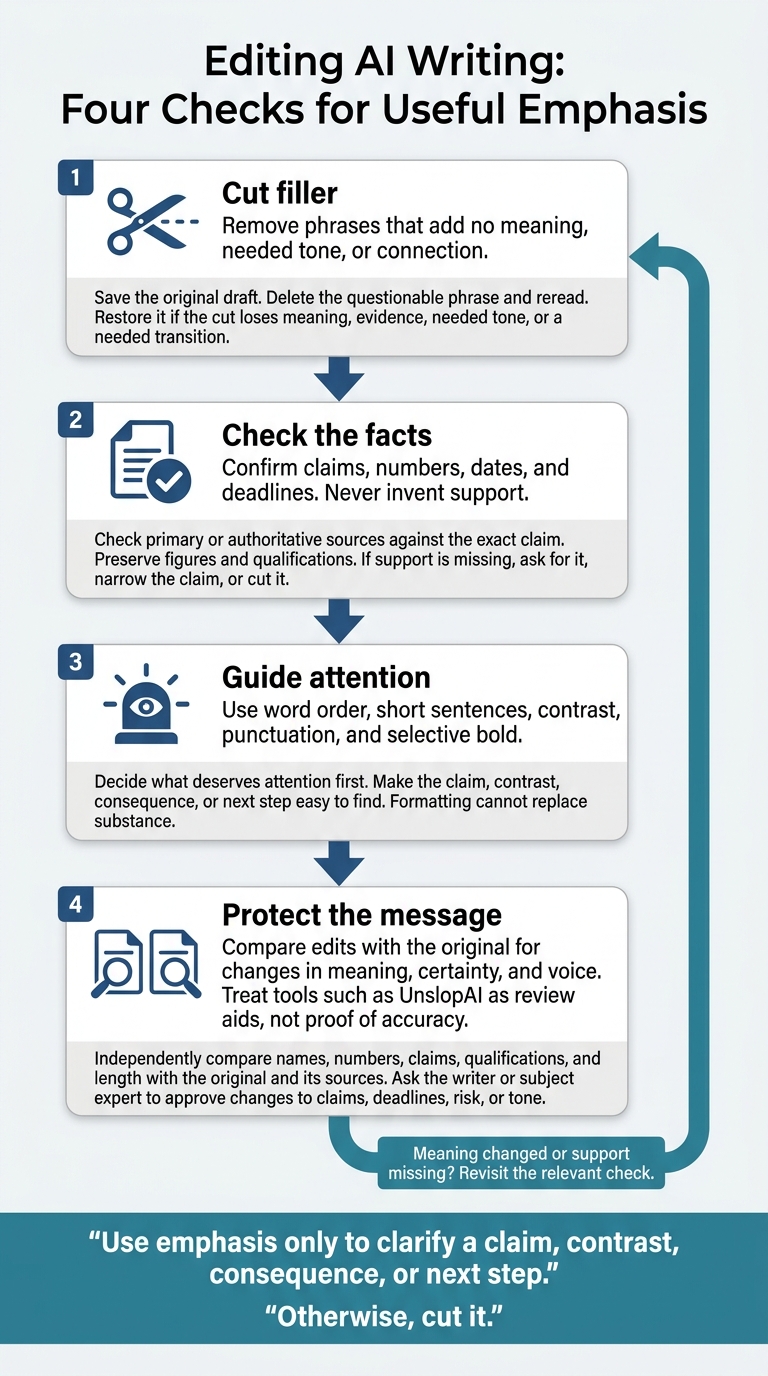
Editing AI drafts comes down to four checks: (Before you start, spot the AI in your current drafts to see where emphasis is lacking.)
- Cut filler: Remove phrases that add no meaning, needed tone, or connection.
- Check the facts: Confirm claims, numbers, dates, and deadlines. Never invent support.
- Guide attention: Use word order, short sentences, contrast, punctuation, and selective bold.
- Protect the message: Compare edits with the original for changes in meaning, certainty, and voice. Treat tools such as UnslopAI as review aids, not proof of accuracy.
The goal isn’t simply fewer words. It’s making the right details easier to find.
How to Spot Empty Emphasis
Use these phrases as a checklist when deciding what to cut.
Phrases That Announce Importance
Treat these phrases as editing signals, not automatic errors. “It’s important to note that” and “It’s worth noting that” often delay the subject and verb. “This is a crucial point” labels importance without explaining it. Cut them unless they add information.
“Make no mistake” can signal a firm warning. “Let that sink in” can create a pause after a supported claim. In routine instructions, both feel heavy. “In today’s fast-paced world” needs scrutiny: does that generic setting help readers understand this particular issue, or merely postpone it?
“This matters because”: use it only when the reason names a consequence, risk, benefit, or decision. If the reason adds no new information, cut the phrase. If the reason stands clearly on its own, lead with it instead.
Test What You Can Delete
Remove the phrase you're questioning. Did you lose meaning, evidence, needed tone, or a needed transition? If not, keep the cut. Start with the main subject and action.
Keep qualifications and words that show how ideas connect. A shorter sentence isn't better if it hides a contrast or weakens a needed warning.
Test formatting the same way. Remove an em dash, repeated exclamation points, or bolding. Keep only what marks an actual aside, contrast, or point readers need to spot while scanning. Formatting can emphasize a point, but it can't replace substance. Apply this same cut-and-test method to the paired rewrites below. For more tips on writing with AI without losing your voice, explore our latest guides.
Empty vs. Useful Emphasis: Paired Examples
These examples are hypothetical. Never add made-up facts to a real draft.
Empty emphasis Useful emphasis Why the useful version works Claims - support: “Our support team provides outstanding billing assistance.” “Our support team answers billing questions within one business day.” Replaces praise with a measurable service commitment. Claims - results: “The campaign was a massive success.” “The campaign generated 42 qualified inquiries.” Reports a specific outcome without labeling it a success. Consequences: “Late invoices are extremely important to address.” “Late invoices can delay payroll.” Names the operational risk instead of merely announcing importance. Contrasts: “Our billing plans are very different and offer great value.” “Monthly billing offers flexibility; annual billing lowers the yearly cost.” Gives readers two differences they can use to choose a plan. Instructions: “This deadline is extremely important, so act immediately.” “The deadline moved to Friday, so submit the form by 5 p.m. ET.” Identifies the change, required action, and cutoff.
Here’s what to check before using facts to add emphasis.
Claims: Replace Praise With Facts
Before promising a response time, check current policies, service records, hours, scope, and exceptions. For campaign results, verify the reporting period, source data, and definition of qualified inquiry. A count alone proves nothing without a goal or benchmark.[4][5]
Consequences and Contrasts: Show What Changes
Check that the consequence applies. Late invoices don’t delay every payroll. Before describing a billing plan as flexible, review its cancellation terms. Before claiming annual savings, compare the same service period and account for discounts, fees, and taxes.
Instructions: State the Action and Deadline
Verify the deadline. Use an exact date if “Friday” could leave readers guessing. Give the governing time zone - not the writer’s local zone - and note regional differences. Make the action, deadline, and time zone clear.[3][6]
How to Direct the Reader’s Attention
Once you’ve removed empty emphasis, use order and formatting to guide the reader’s attention. Keep emphasis that changes meaning, priority, or action - not words that just add drama. Decide what deserves attention first. Then adjust sentence order, punctuation, or formatting.
Use Priority, Word Order, and Short Sentences
These hypothetical pairs show three ways to guide attention. The original wording isn’t always wrong. Each revision simply shifts the focus.
Before After What changes Please review the proposal carefully. Review the payment terms first. Replaces a vague reminder with a specific priority. Friday is the deadline for approval. Approval is due Friday. Moves the deadline to the end and makes the action more direct. The migration starts Monday and checkout will be unavailable. The migration starts Monday. Checkout will be unavailable. Gives the interruption its own sentence.
Match word order to your priority. Where you place a deadline depends on what readers need to notice. Give the checkout interruption its own sentence only if it needs separate attention. Don’t split sentences just to make them shorter.
Punctuation follows the same rule: use it when it helps readers focus.
Use Punctuation, Contrast, and Bold With Purpose
Get the wording clear before adding these devices. A colon introduces the key action. Contrast sets a boundary. Selective bold helps readers find a detail.
Before After What changes There is one remaining step, which is signing. One step remains: sign. The colon connects the remaining step directly to the action. Speed is extremely important. Shorten the introduction, not the safety instructions. The contrast identifies what to cut and what to preserve. Submit the form by 5 p.m. ET. Submit the form by 5 p.m. ET. Narrower bold draws attention to the cutoff.
Use contrast to set a real priority. Bold the cutoff so readers can spot it - not to decorate the whole instruction. When everything is emphasized, nothing stands out.
A Workflow for Editing AI Drafts
After cutting empty emphasis, follow a repeatable process to check what remains.
Cut Filler and Check the Facts
Save the original draft. Mark empty emphasis, delete it, and reread the paragraph. Put emphasis back only when it clarifies priority, contrast, consequence, or action. Then verify every remaining claim.
Use only the source material. Check claims against primary or authoritative sources. The evidence must support the exact claim, date, or deadline stated. Keep figures and qualifications intact. If support is missing, ask for it, narrow the claim, or cut it. Don’t turn an unverified benefit into a promised result.
Compare the rewrite with the original for shifts in certainty, scope, or intent. Check whether punctuation, bolding, headings, or sentence length changed the meaning. Keep a short log of major edits, and ask the writer or subject expert to approve changes to claims, deadlines, risk, or tone.
Review Rewrites With UnslopAI
For AI-polished drafts, use UnslopAI to flag wording that sounds stronger than it is. Its before-and-after diffs let you inspect each edit. Slop scoring flags stock phrasing, while fidelity checks help you compare names, numbers, claims, and length with the original. Use these features to guide your review - not replace it.
A lower score doesn’t prove the writing is better. Independently check names, numbers, claims, qualifications, and length against the original and its sources. Read for the writer’s voice, too. Reject edits that cut needed context, change certainty, or flatten intentional wording - even when the rewrite sounds smoother.
Conclusion: Keep Emphasis That Clarifies
Calling something important without support asks readers to take your word for it. Give them concrete information instead: what’s different, what changes, or what they need to do.
Save strong wording and bold type for details readers might otherwise miss.[2][1]
Use emphasis only to clarify a claim, contrast, consequence, or next step. Otherwise, cut it. When support is missing, narrow the claim, state the uncertainty, or remove it. Never invent evidence.
FAQs
How can I emphasize a point without hard data?
Replace vague claims and inflated language with firsthand details and a clear point of view. Say what happened, describe your experience, or state your opinion plainly. If a process is tedious, call it tedious.
Mix short sentences with longer ones to give key points more weight. Cut filler openers like “It’s important to note,” and swap overblown adjectives for specific descriptions or clear reasoning. UnslopAI can help remove filler without changing your voice or meaning.
How do I keep persuasive writing from sounding flat?
Skip generic templates and transitions that say nothing. Use your own voice, make clear judgments, and include specific details. Vary sentence length. Trade buzzwords for concrete results and stiff phrasing for language you'd actually use. If a rewrite sounds generic, go back to your original wording.
UnslopAI provides before-and-after comparisons and slop scoring to help you spot and remove machine-like writing patterns without changing your meaning.
When does repeated emphasis help readers?
Repeat a point only when it helps the reader, not to fill space. Vary sentence length to build rhythm and show what matters. A short sentence can spotlight a key idea, while a longer one can connect ideas without sounding robotic.
For warnings or strong emphasis, use full word forms rather than contractions. This signals a more serious tone.