I rewrite AI drafts one section at a time - not all at once - to keep changes easy to check. My rule: change the wording, but keep the claims, names, numbers, and limits intact.
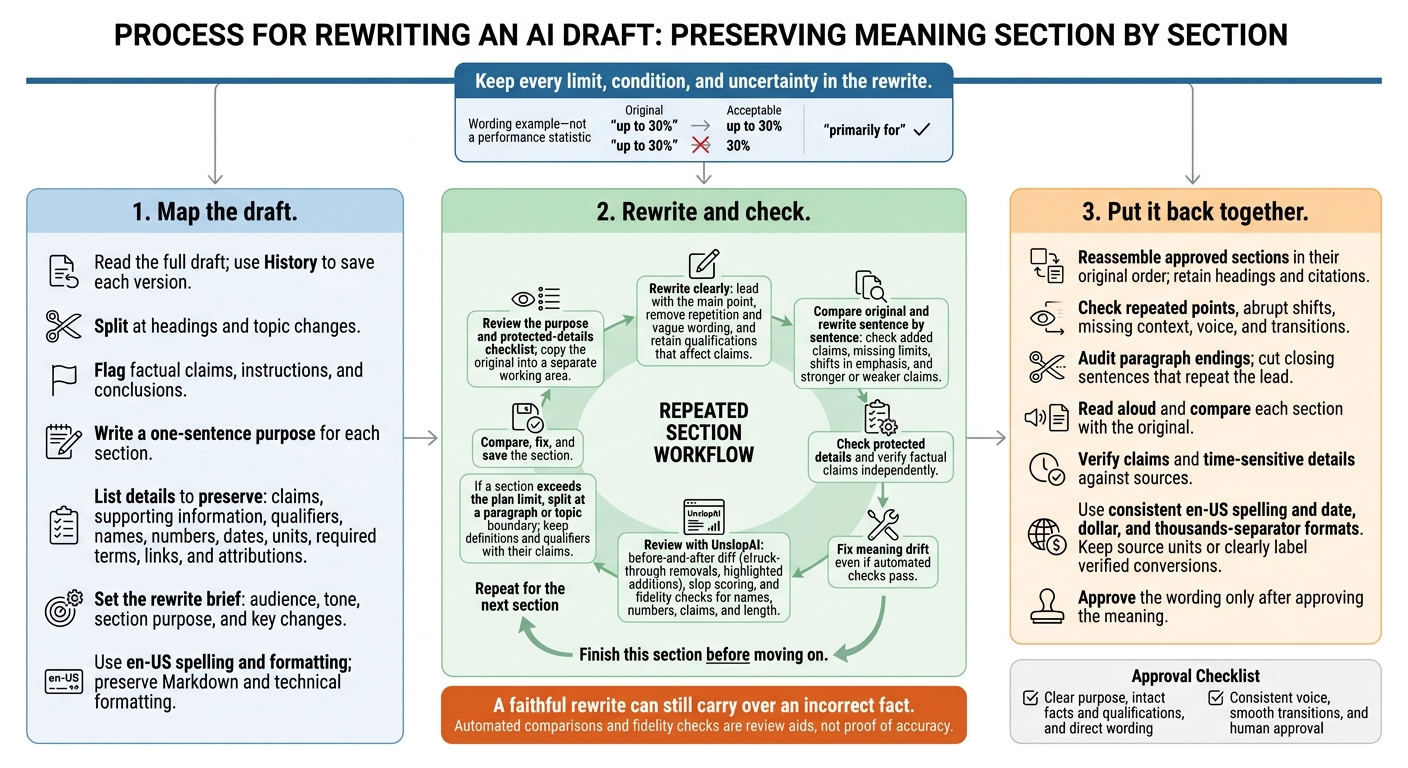
I follow 3 steps:
- Map the draft: split it by heading or topic, list details to preserve, and set the audience and tone.
- Rewrite and check: make each section clear, compare it with the original, and check facts separately.
- Put it back together: review the voice, transitions, citations, and meaning before approving it.
I use UnslopAI’s comparisons and fidelity checks to help spot the AI changes - not to prove accuracy. My final check is the meaning: smoother wording must not turn “up to 30%” into “30%.”
Step 1: Map the Draft and Set Rewrite Rules
Read the full draft once before you rewrite it. Use History to save each version[1][4]. Set rewrite rules to keep the sections aligned as you work.
Split the Draft at Headings and Topic Changes
Start with headings as section boundaries. Split a section further when the topic changes. Flag factual claims, instructions, and conclusions for close review, then write a one-sentence purpose for each section. This gives you a clear focus for each rewrite.
List Details to Preserve
Record each section’s claim, supporting information, and qualifiers. Keep names, numbers, dates, units, required terms, links, and attributions intact[1].
Keep qualifiers like “up to” and “primarily for” unchanged.
Treat this list as your nonnegotiable checklist. Preserving meaning doesn't confirm that a claim is true, so fact-check separately. Once you've set these rules, rewrite one section at a time.
Write a Short Rewrite Brief
Before rewriting, define the audience, tone, section purpose, and key changes. Use en-US spelling and formatting, and preserve Markdown and technical formatting[5]. Apply the same rules to every section, changing only the purpose and local edits.
Use this brief to rewrite each section in Step 2.
Step 2: Rewrite and Check Each Section
Before editing, review the purpose statement and protected-details checklist from Step 1. Copy the original section into a separate working area. State its purpose in one sentence, then follow your rewrite brief. Finish this section before moving on. Use this setup for the sentence-by-sentence check below.
Make the Wording Clear and Direct
Lead with the main point. Remove repeated ideas, vague wording, empty qualifiers, and generic transitions. Keep any qualifications that affect the claim. Use concrete verbs and vary sentence openings. Read awkward sentences aloud to spot phrasing that doesn’t sound natural. Let paragraph length and structure vary, too.
Check Meaning and Protected Details
Compare the rewrite with the original sentence by sentence. Check for added claims, missing limits, shifts in emphasis, or wording that strengthens or weakens a claim. Review protected details against your checklist, then verify factual claims independently. A faithful rewrite can still carry over an incorrect fact.
Review Changes With UnslopAI
After your manual review, run the section through UnslopAI to check for meaning drift you may have missed.
Paste the section into UnslopAI. Review its before-and-after diff: struck-through text shows removals, and highlighted text shows additions.[2] Use slop scoring to measure how much machine-like phrasing you removed. Then review fidelity checks for names, numbers, claims, and length. These are review aids, not proof of accuracy. Fix meaning drift even when the automated check passes.
If the section exceeds your plan limit, split it at a paragraph or topic boundary.[1] Keep definitions and qualifiers with the claims they explain. Compare each part with the original, fix any remaining issues, and save the final section. Then repeat the process for the next section.
Step 3: Reassemble and Review the Draft
Put the approved sections back in their original order, with headings and citations intact. Read the assembled draft once to flag repeated points, abrupt shifts, and missing context. Check that the voice reads as one piece. For more tips on writing with AI without sounding like it, visit our blog.
Check Tone and Transitions
Use your rewrite brief to compare formality, point of view, and terminology across sections. Keep the voice consistent and smooth out transitions without adding filler.
Audit paragraph endings: cut closing sentences that repeat the lead.[2]
Once the voice is steady, move to the final meaning and fact check.
Run the Final Meaning and Fact Check
Read the finished piece aloud to catch repetitive rhythms or formulaic paragraph structures. Then compare each section with the original, checking names, numbers, and claims.
Before publication, verify claims and time-sensitive details against their sources. Use consistent en-US spelling and formats for dates, dollar amounts, and thousands separators. Keep source units, or clearly label any verified conversions. Treat automated checks as supporting evidence - not a substitute for your editorial judgment.
Conclusion: Use the Section Checklist
Work section by section. Give each part one clear purpose, make focused edits, and check that the meaning stays intact. For the final pass, use this checklist:
- Clear purpose, intact facts and qualifications, and direct wording
- Consistent voice, smooth transitions, and human approval
Keep every limit, condition, and uncertainty in the rewrite.
Then use UnslopAI’s diff and fidelity checks to verify that names, numbers, and claims remain intact as you make the draft sound more human. Approve the wording only after you approve the meaning.
FAQs
How do I handle claims that span sections?
Keep claims consistent across sections by replacing broad AI wording with specific, verifiable details. Instead of vague terms like “affordable” or “recently updated,” state the price or date: $4.99 per month or Aug. 1, 2026.
UnslopAI can revise these sections without changing your original meaning or factual claims. It removes machine-like wording and filler that can make related points harder to connect.
What if I find an error in the original draft?
Correct factual errors manually before or after using UnslopAI to polish the tone. UnslopAI removes machine-like phrasing, smooths the rhythm, and fixes structure while keeping your original meaning, factual claims, and data intact.
That focus on preserving your message means it won’t automatically detect or correct factual errors in the source text. Use it as a final polish for voice and flow - not as a fact-checking service.
What if UnslopAI’s fidelity checks miss a change?
Use the before-and-after diffs to check accuracy and see exactly what changed [2][3]. UnslopAI’s built-in fidelity check is designed to keep your original meaning, numbers, names, and claims intact. If a rewrite fails the check, UnslopAI automatically discards it and provides a safer version instead [1].