Most AI-sounding writing is easy to spot for one reason: it relies on the same safe phrases over and over. Readers can spot the AI text apart about 75% of the time, and the clue is often the wording, the transitions, and the neat paragraph endings.
If I wanted to sum up the full article fast, I’d say this:
- Cut generic openers like “In today’s fast-paced world”
- Remove filler phrases like “It’s important to note” and “Let’s delve into”
- Watch for template patterns like “Whether you’re X or Y” and “Not just X, but Y”
- Replace buzzwords like “game-changer” with plain results
- Fix smooth but flat rewrites that strip out your voice
The big point is simple: if a sentence could fit almost any blog post, email, or LinkedIn post, it probably needs work. The article shows 10 common phrases that make writing sound generic, plus plain rewrites that sound more like a person.
The 10 phrases and patterns covered are:
- “In today’s fast-paced world”
- “It’s important to note”
- “Let’s delve into”
- “A tapestry of”
- “Whether you’re a X or a Y”
- “Not just X, but Y”
- “In conclusion”
- “On the other hand”
- “Game-changer”
- Over-polished rewrites that erase your voice
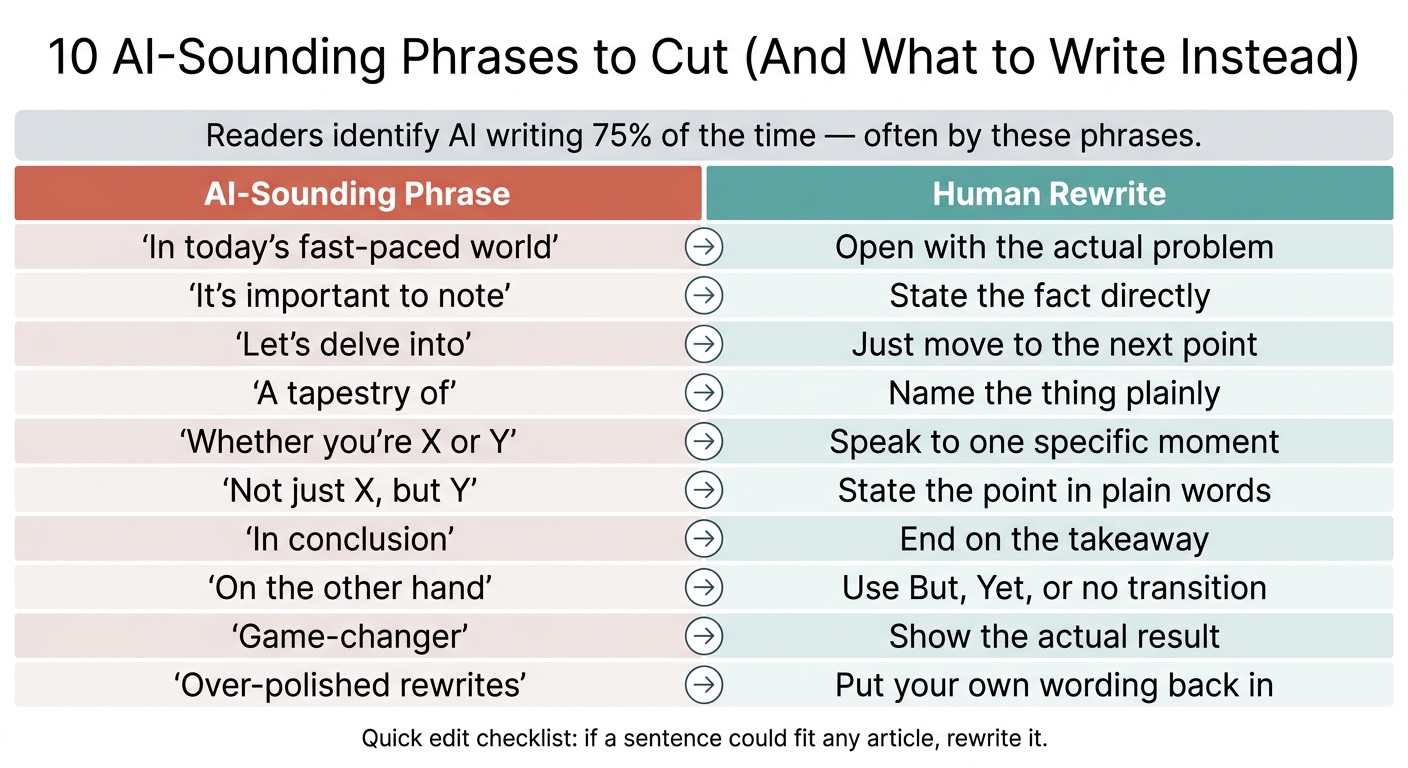
Common words used by AI - AVOID THEM
Quick Comparison
| Phrase or Pattern | Why It Stands Out | Better Fix |
|---|---|---|
| In today’s fast-paced world | Vague opener | Start with the point |
| It’s important to note | Empty filler | Say the fact directly |
| Let’s delve into | Announces the move | Just move to the next point |
| A tapestry of | Pretty but vague | Name the thing plainly |
| Whether you’re X or Y | Template setup | Speak to one clear moment |
| Not just X, but Y | Empty contrast | State the point in plain words |
| In conclusion | Formula ending | End on the takeaway |
| On the other hand | Neat but stiff transition | Use a shorter contrast or none |
| Game-changer | Big claim, little proof | Show the result |
| Over-polished rewrites | Sounds flat and generic | Put your own wording back |
My takeaway: this article isn’t just a list of bad phrases. It’s a simple editing check for making your draft sound less like a template and more like you.
Quick Table: AI-Sounding Phrases and Natural Rewrites
Use this table as a quick scan for easy fixes. Some entries are exact phrases. Others are the kind of polished rewrites that make writing sound smooth but a little flat.
| AI-Sounding Phrase | Why It Sounds Like AI | Natural Rewrite |
|---|---|---|
| "In today's fast-paced world" | Overused, generic filler that slows down the opening | Open with the problem. |
| "It's important to note" | Stiff and formal. It reads like a report, not a person | State the fact. |
| "Let's delve into" | Common setup with a polished, predictable rhythm | Look at this. |
| "A tapestry of" | Flowery metaphor that sounds dressed up for no reason | Use "A mix of" or say exactly what you mean. |
| "Whether you're [audience A] or [audience B]" | Template-style setup that sounds copied from a formula | Name the reader directly. |
| "Not just X, but Y" | Safe contrast pattern that can feel machine-made | Put both ideas in one plain sentence. |
| "In conclusion" | Default closing line that sounds formulaic | Use "Finally", "The takeaway is", or just end on the point. |
| "On the other hand" | Transition that can sound a little too neat | Use "But", "Still", or rewrite the sentence. |
| "Game-changer" | Buzzword that skips over what actually happened | Describe the result instead. |
| Overly polished rewrites that erase your voice | Flattens voice, stakes, and sharp examples | Bring back your own wording and one specific example. |
"There is a certain rhythm to it [AI writing], the way it structures paragraphs, the way it wraps up with a summary sentence, the way transitions feel slightly too smooth." - BitTide [1]
The right column gives you the fast fix: swap generic wording for language that sounds direct and human. Next, we’ll break down each phrase and show a cleaner rewrite.
1. "In today's fast-paced world"
This phrase pops up all the time in AI-written drafts because it's a generic opening line. It doesn't tell the reader anything specific about the topic, the problem, or why it matters.
Example:
"In today's fast-paced world, businesses need to communicate faster than ever before."
That's why it feels generic. The sentence is broad and stiff, and as Stas Leonov notes, the phrasing is stiff and overly polished. [2]
A better move is to name the actual problem. Start with what's at stake instead of leaning on a filler opener.
"Businesses need faster communication to keep up with customer expectations."
2. "It's important to note"
This phrase is filler. It sounds polished, but it doesn’t add anything.
Most of the time, the sentence works better when you get straight to the point.
Example:
"It's important to note that skipping the editing step can hurt your credibility."
Cut the opener, and the line gets sharper:
"Skipping the editing step can hurt your credibility."
So what’s the issue? The phrase adds formality without adding substance. Here’s a simple test: delete it and read the sentence again. If the meaning stays the same, the opener was filler.
This kind of scaffolding can make a sentence sound polished but generic [3]. The same delete-and-read test works on the next phrase too.
3. "Let's delve into"
This is a quieter version of the same issue: the sentence tells you it's about to move instead of just moving. "Let's delve into" shows up a lot in AI drafts as filler between paragraphs. It's a bridge phrase that sounds like progress, but it doesn't actually say much. Most readers pick up on that pattern fast, and it reads like stock AI language. It also slows the line before the point even arrives.
The problem is the whole phrase. It stalls the sentence without giving the reader anything in return.
As Stas Leonov put it, "The phrasing feels stiff, the word choices are too safe, everything's overly polished in a way that makes it actually harder to read." [2]
The fix is simple: start the next sentence. Don't announce the transition. Use plain, direct phrasing instead.
| Instead of | Try this |
|---|---|
| "Let's delve into why this matters." | "Here's why this matters." |
| "Let's delve into how this works." | "This is how it works." |
| "Let's delve into the details." | "Here are the details." |
The rewrite just needs to be direct.
4. "A tapestry of"
This phrase decorates the sentence instead of explaining it. “A tapestry of experiences,” “a tapestry of ideas,” “a tapestry of voices” - it may sound polished, but it blurs the point. The better move is simple: say what’s there.
This one is easy to miss because it feels descriptive. But it still dodges the details. “A tapestry of” suggests complexity without spelling out what that complexity is. The reader is left with a nice-sounding phrase and no clear picture.
BitTide puts it this way:
"Every system's default voice is smooth and anonymous. If you don't put your voice back in, whatever comes out will read as the platform, not you." [3]
That’s the problem with “a tapestry of.” It fills space without naming anything concrete. It sounds polished, but the reader can’t see the subject. If a phrase sounds pretty while hiding the point, cut it.
| Instead of | Try this |
|---|---|
| "A tapestry of experiences" | "A mix of real experiences" |
| "A tapestry of voices" | "Views from several people" |
| "A tapestry of ideas" | "Several competing ideas" |
Name the mix, the people, or the ideas.
5. "Whether you're a X or a Y"
This is the audience version of the same issue: broad phrasing that skips over the reader's actual moment. "Whether you're a beginner or an expert" sounds open to everyone, but it stays vague. It sounds like it's speaking to all readers, yet it doesn't land on anyone in particular. The issue is simple: it names roles, not situations.
Peter Stockwell, Professor of Literary Linguistics, University of Nottingham, puts it plainly:
"If you want something that's very familiar and very mediocre and entirely functional, it's [AI] amazingly good at that." [4]
That makes the line usable, but easy to forget.
A better move is to drop the role labels and name the moment instead. Say "If you're struggling to keep up with grading…" or "When you're staring at a blank page…". That's the difference between talking at a crowd and speaking to one person.
| Instead of | Try this |
|---|---|
| "Whether you're a beginner or an expert" | "When you're staring at a blank page..." |
| "Whether you're a teacher or a student" | "If you're struggling to keep up with grading..." |
6. "Not just X, but Y"
This is the contrast version of the same safe, templated writing. It sounds persuasive, but most of the time, it doesn’t say much.
The issue is the fake contrast. "It's not just a tool, but a solution" - what does that tell you, exactly? Not much. The line creates the feel of contrast without adding detail, opinion, or a reason to care. The sentence is grammatically fine, but it’s still empty.
A better move is simple: break it into two sentences or say the second idea outright. Instead of "It's not just a checklist, but a complete editing system," write "It's a checklist you can actually use to edit your own drafts." Same idea. Clearer point. Less fluff.
The fix is to cut the pattern and state the point plainly. Here’s how that looks:
| Instead of | Try this |
|---|---|
| "It's not just a tool, but a solution" | "It's a tool that solves the problem" |
| "Not just informative, but transformative" | "It explains the issue and shows what to do next" |
| "Not just a checklist, but a complete system" | "It's a checklist you can use to edit your own drafts" |
7. "In conclusion"
This habit pops up at the end of drafts too. AI writing often lands on neat, polished summary lines, and "In conclusion" is one of the clearest signs of that pattern [1].
Cut the label and finish with the point itself. If the last paragraph already says what you mean, stop there. If you want a final line, make it concrete. Call back to an earlier detail, or say exactly what the reader should do next.
"So next time you edit a draft, start with these ten phrases" does more work than "In conclusion, these phrases are worth watching out for." Same meaning. Just more natural.
The fix is simple: end with the point, not the label.
| Instead of | Try this |
|---|---|
| "In conclusion, these tips will help you write better" | "Use these next time you edit a draft" |
| "In conclusion, AI writing has its limitations" | "AI is useful - but it still needs a final pass" |
| "In conclusion, it's important to review your content" | "Read it back once before you hit publish" |
8. "On the other hand"
"On the other hand" is one of the easiest contrast phrases to spot. It’s a default move when the writing shifts from one idea to the opposite one. You see it all the time in blog posts, LinkedIn content, and emails. Use it a few times, and the writing starts to feel formulaic.
The fix is often simple: delete the transition. If the contrast is already clear, cut it. If you do need a bridge, try "But", "Yet," or "The problem is." Use "At the same time" only when both ideas can be true at once. Use "The problem is..." when you want to name the downside head-on. And if the sentence still works without any transition, leave it out.
| Instead of | Try this |
|---|---|
| "On the other hand, the cost can add up quickly" | "But the cost adds up fast" |
| "On the other hand, some readers prefer shorter posts" | "Some readers prefer shorter posts" |
| "On the other hand, this approach has real drawbacks" | "The problem is that this approach has real drawbacks" |
9. "Game-changer"
"Game-changer" shows up all the time in business and marketing copy. The issue isn't the word itself. It's the lack of detail behind it.
If you call something a "game-changer" and stop there, readers get a claim, not proof. It sounds polished, but it doesn't say much.
In 2026, Plexigrid cut query times from 5 minutes to 0.5 seconds by using TimescaleDB's hypertables and continuous aggregates. [2] That's a result. "Game-changer" isn't.
| Instead of | Try this |
|---|---|
| "This tool is a game-changer for marketers" | "This tool reduced our processing time by 40%" |
| "A game-changing update to our platform" | "The update cut query times from 5 minutes to 0.5 seconds" [2] |
Name the result, not the label.
The next trap is worse: wording that sounds polished but strips out your voice.
10. Overly Polished Rewrites That Erase Your Voice
AI doesn't just change a few words. It can smooth out your whole draft until it loses the sound of you.
A rewrite may look cleaner on the page. But that polish often comes with a cost: your phrasing gets toned down, your rhythm gets evened out, and the draft starts sounding like it came from a generic template instead of a real person.
"There's this distinct tone that just screams bot - the phrasing feels stiff, the word choices are too safe, everything's overly polished in a way that makes it actually harder to read." - Stas Leonov, Writer [2]
That’s the core problem. It’s not only about obvious word swaps. Even after light editing, AI sentence patterns can stick around and still feel artificial.[1]
A better way to use AI is to let it help with structure, not voice. Use it to sort ideas, tighten the flow, or help you expand a rough point. Then go back through the draft and put your language back in. If a rewrite sounds smoother but less specific, that's a red flag. Bring back your wording before you hit publish.
Use the checklist below to spot those patterns before you send or post.
How to Use This Checklist Before You Send or Publish
Use the list above as a quick edit pass.
Start at the opening line and trim broad, generic setups. If the first sentence takes too long to get to the point, tighten it.
Next, scan for filler transitions. Cut phrases like "it's important to note", "let's delve into", and "in conclusion." If the sentence still makes sense without them, remove them. Simple test, right?
Then check for abstract language. That usually means polished wording that sounds nice but doesn't point to anything specific. For example, "A tapestry of solutions" can often become a plain noun plus a direct verb.
Finally, read the last sentence of each paragraph out loud. If that closing line just repeats what the paragraph already said, cut it.
These same checks work for LinkedIn posts, emails, newsletters, and blog intros.
Conclusion
No single word gives away AI writing by itself. What sets off alarm bells is the pattern: smooth transitions, neat little wrap-ups, and phrases that could drop into almost any article on almost any subject.
Before you publish, do one last pass. Look for lines that feel generic or interchangeable. A simple test works well: if a sentence could belong to almost anyone, rewrite it. If it doesn't carry your angle, your detail, or your way of saying it, rewrite it.
That's the test that matters. Does the sentence sound like you or like a template? Your voice is the whole point. Use these phrases as a final check for generic wording that could come from anywhere.
FAQs
How can I spot AI-sounding writing fast?
Watch for patterns like stiff phrasing, overly cautious word choices, and a polished rhythm that doesn’t sound like a person.
Other clues show up in the structure too: paragraphs that all move the same way, repetitive closing lines, transitions that feel a little too smooth, and a voice so generic it could belong to anyone. Human writing usually has more texture. It carries perspective, personal stakes, and clear judgment.
Can I use AI without losing my voice?
Yes. You can use AI without losing your voice.
The key is to treat AI as a draft partner, not the final writer. Refinement tools help by stripping out the stiff patterns that often make AI text sound off, while keeping your tone and meaning in place.
Raw AI output usually has a robotic feel. You can hear it in the rhythm, the sentence patterns, and those overly neat transitions. A good rewrite pass smooths that out, so the final piece sounds more natural and more like you.
What should I replace generic AI phrases with?
Replace generic AI phrasing with wording that sounds more like you. Use more personal pronouns, mix up sentence structure, and trade polished filler for plain, conversational language.
You can also use UnslopAI to spot AI-like patterns and clean up the prose without changing your original meaning.