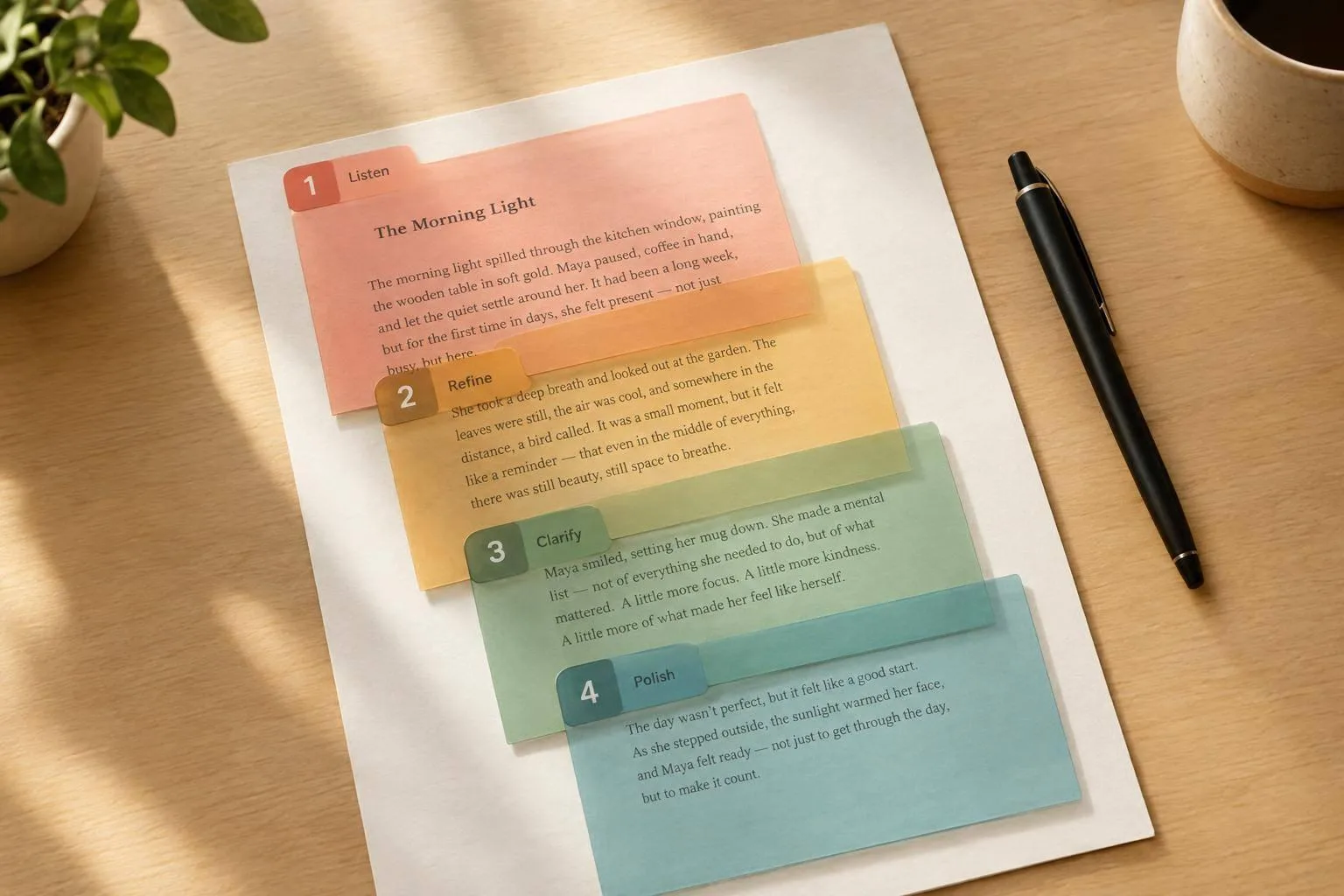
I edit AI drafts aloud to fix awkward wording - not to change what they say. My process has 4 steps: check the structure, read and mark rough spots, revise wording and rhythm, then compare the edits with the original.
Here’s what I check:
- Clarity: Clear subjects, direct verbs, and references you can follow.
- Rhythm: Sentence lengths and pauses that fit the message.
- Voice: Wording that still sounds like the intended writer.
- Accuracy: Names, numbers, dates, and qualifiers such as “may” stay intact.
Smoother does not mean shorter at any cost. I keep longer sentences when they’re easy to follow and preserve formal wording when the draft calls for it.
For an optional rewrite, I can use UnslopAI and review each change. The article lists 5 free rewrites and paid plans starting at $4.99/month, with text stored for 48 hours. My final check stays the same: read the whole draft aloud and confirm that the meaning hasn’t changed.
Proofreading Tips: Read Aloud
Read-Aloud Edits: Before-and-After Examples
These examples show how to spot the AI and apply three main fixes: split overloaded sentences, use direct verbs, and link paragraphs to a clear detail.
Split Overloaded Sentences and Vary Rhythm
Start a new sentence when the message shifts from progress to timing.
Check Before-and-after comparison Problem Before: “We have completed the initial review of the proposed changes, which include updates to the payment page and confirmation email, and we can begin testing on Monday if you approve the revised copy by Friday.” Edit After: “We have reviewed the proposed changes to the payment page and confirmation email. If you approve the revised copy by Friday, we can begin testing on Monday.” Why it works aloud The listener hears the progress first, then the condition and next step. Meaning preserved Same claim, same limits.
To vary the rhythm, follow a short action with a longer explanation:
“Please review the copy. Focus on the payment instructions, where customers need a clear explanation of the next step.”
Use plain wording instead of stacking modifiers. Let the message guide sentence length, rather than sticking to a fixed limit.
Use Direct Verbs and Clear Subjects
When responsibility matters, put the subject before the action.
Check Before-and-after comparison Problem Before: “The implementation of the revised process will be undertaken by our team.” Edit After: “Our team will implement the revised process.” Why it works aloud The listener hears who’s responsible first, followed by a verb that states the action. Meaning preserved Same claim, same limits.
But direct wording must still leave room for uncertainty:
“Our team may implement the revised process” cannot become “Our team will implement the revised process.”
Keep any words that qualify the claim.
Connect Paragraphs Without Changing Claims
Connect the next paragraph to a detail you’ve already introduced. Replace a vague closing line with a specific requirement.
Check Before-and-after comparison Problem Before: “The revised process may reduce processing time for online requests.”
“The revised process requires staff training before use. In conclusion, this is an important development.”Edit After: “The revised process may reduce processing time for online requests.”
“Before staff can use it, they need training.”Why it works aloud The pronoun refers back to the process, and the ending states what staff need before using it. Meaning preserved Same claim, same limits.
The next section turns these patterns into an editing workflow you can use again.
A Step-by-Step Read-Aloud Editing Workflow
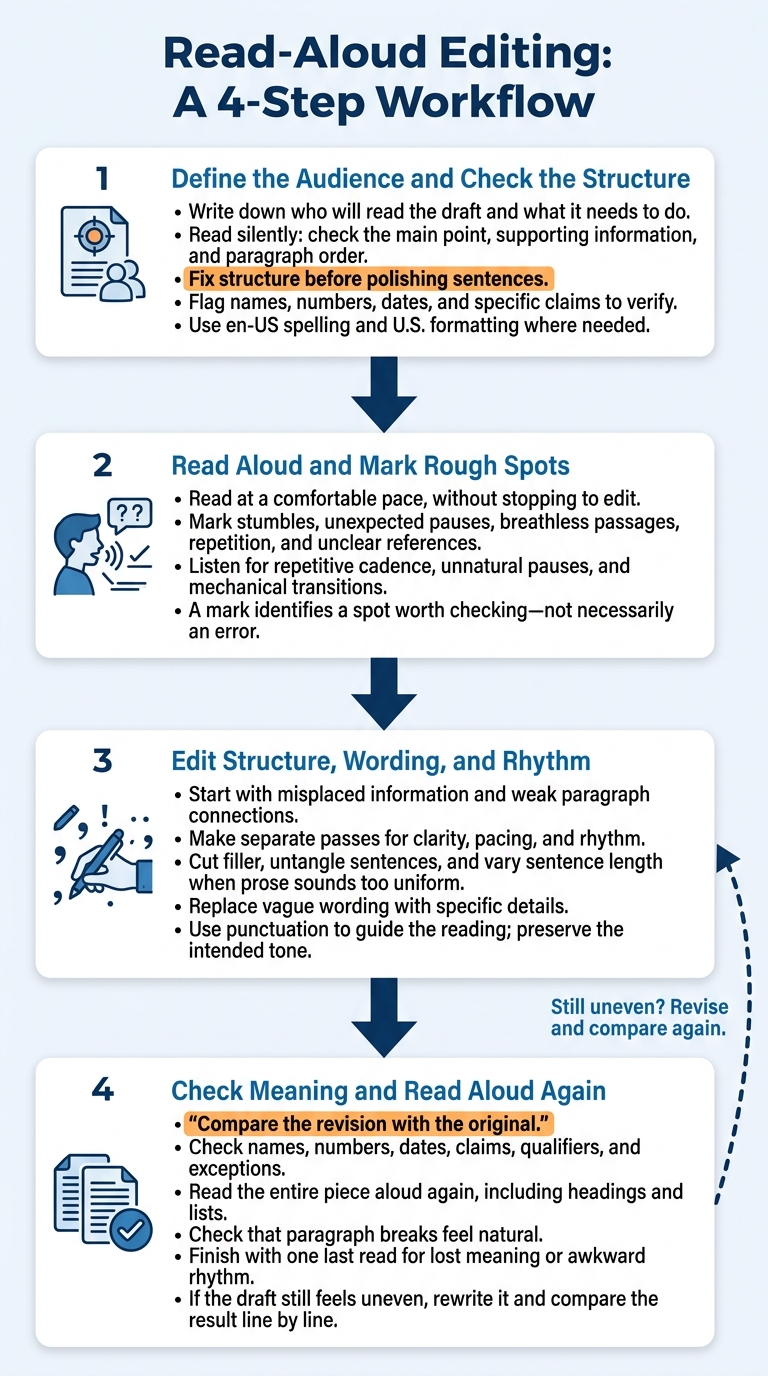
Define the Audience and Check the Structure
Write down who will read the draft and what it needs to do. Then read silently. Is the main point clear? Does the supporting information belong? Do the paragraphs follow a logical order? Fix structure before polishing sentences. Flag names, numbers, dates, and specific claims to verify. Use en-US spelling and U.S. formatting where needed.
Read Aloud and Mark Rough Spots
Read at a comfortable pace, without stopping to edit. Mark places where you stumble, pause unexpectedly, run out of breath, repeat yourself, or lose track of a reference. Listen for repetitive cadence, unnatural pauses, and mechanical transitions. Each mark points to a break in the flow - not necessarily an error, but a spot worth checking.
Edit Structure, Wording, and Rhythm
Start with misplaced information and weak connections between paragraphs. Then make separate passes for clarity, pacing, and rhythm. Cut filler, untangle sentences, and vary sentence length when the prose sounds too uniform. Replace vague wording with specific details. Use punctuation to guide how each sentence sounds aloud, and keep the wording in line with your intended tone. For more insights on writing with AI without losing your voice, explore our latest guides.
Check Meaning and Read Aloud Again
Compare the revision with the original to check names, numbers, dates, claims, and qualifiers. Make sure no qualifiers or exceptions disappeared during editing. Then read the entire piece aloud again, including headings and lists, and check that paragraph breaks still feel natural. Finish with one last read for lost meaning or awkward rhythm. If the draft still feels uneven, rewrite it and compare the result line by line.
Use UnslopAI for an Optional Rewrite
For a faster final pass after your manual read-aloud edits, use UnslopAI to tighten cadence and wording while keeping the meaning intact.[1]
Review the Rewrite and Compare Changes
Paste your draft into the web app, then compare the original with the rewrite. Keep edits that help the text flow without changing what it says.
Fidelity checks flag changes to names, numbers, claims, and length. If a rewrite fails a check, UnslopAI offers a safer version.[2] Use the score as a guide, not a target. Pushing it too low can flatten your voice.[1]
For regular use, check the plan limits below.
Check Plan Limits and Access
- Free: $0 for 5 total rewrites, up to 1,000 characters each.
- Small: $4.99/month for 250 monthly rewrites, up to 2,000 characters each.
- Pro: $19/month for 600 monthly rewrites, up to 20,000 characters each.
Every plan includes web app access. Pro also includes API and MCP server access for Claude, ChatGPT, and Cursor.[2]
Drafts and rewrites are stored for 48 hours, then deleted. User text is not used for training.[2]
Conclusion: Final Read-Aloud Checklist
Set the purpose, read aloud once, mark rough spots, revise structure first, then wording and rhythm, and check meaning against the source. In that final pass, focus on four things: clarity, rhythm, voice, and accuracy.
Check Clarity, Rhythm, Voice, and Accuracy
Clarity and wording: Can a listener grasp the main point right away? Check for clear subjects, strong verbs, and one main idea per sentence. Fix vague pronouns, overloaded clauses, and filler. Define needed technical terms consistently, give each paragraph one job, and make sure transitions show how ideas connect.
Rhythm and voice: Vary sentence openings and lengths. Listen for awkward pauses and passages that feel rushed, but keep longer sentences when they’re easy to follow. If the draft calls for a formal tone, preserve it - including formal wording, deliberate repetition, and fragments that serve a purpose.
Accuracy: Check names, dates, numbers, units, and claims against the source. Keep qualifications such as “may,” “typically,” and “only.” A smoother sentence is worse if it changes the claim.
The last pass is about mechanics, not adding new ideas.
Final delivery: Read the whole passage without stopping. Check pronunciation and whether the ending offers a specific takeaway or next step. Spell out a term or add pronunciation guidance rather than distort otherwise clear prose.
Stop when the passage is clear, accurate, and smooth - not when every sentence sounds the same.
FAQs
Why does AI writing sound awkward aloud?
AI writing often sounds awkward aloud because it plays it safe on the page. The rhythm falls flat. Sentences follow similar lengths and structures, while vague transitions, extra words, and neat summaries make the writing sound too polished and predictable when spoken [1][2].
It can also lack lived experience or a clear point of view. That leaves the prose feeling distant and generic - and reading it aloud makes those gaps easier to hear [1].
How can I distinguish intentional repetition from filler?
Try the deletion test: remove a phrase or sentence, then read the passage aloud. If the meaning and flow stay the same, it’s probably filler.
Repetition isn’t always filler. Used on purpose, it can emphasize a point, create rhythm, or reinforce an argument. But a closing line that repeats earlier points without adding a new perspective or judgment is filler.
UnslopAI’s before-and-after diffs can help you spot these patterns and robotic structures so you can refine your voice.
How can I check flow in a long draft?
Read the text out loud to spot repetitive cadence and robotic rhythm. Check burstiness - variation in sentence length - and look for variety in sentence openings, clause patterns, and transitions.
Use the UnslopAI API to automate checks, or try the web app for a slop score and a before-and-after diff. Review edits sentence by sentence to cut filler and fix flat structure without losing your natural voice.