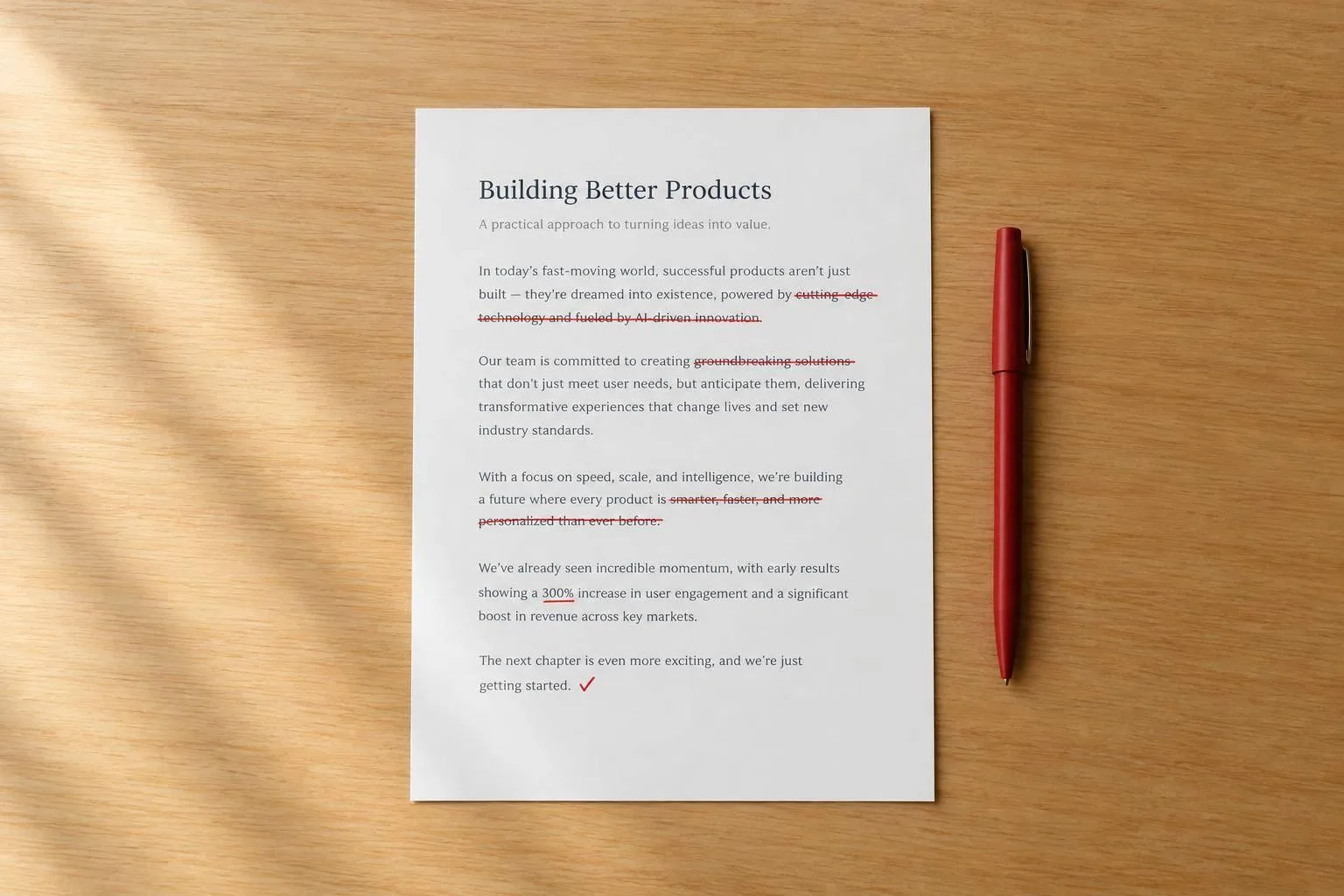
I cut AI hype by replacing empty praise with facts - not by stripping out personality. My first check: If I delete a phrase, do I lose information or just a sales pitch?
I use 3 steps:
- Spot: Flag vague praise, repeated claims, and promises the source doesn’t support.
- Rewrite: Say who did what. Add results only when the source supports them, and keep the writer’s warmth.
- Check: Compare names, numbers, dates, scope, and qualifiers with the original. I treat UnslopAI’s scores and suggested edits as review aids, not approval.
My rule: Change the wording, not the claim. “Could” must stay could - not become “will.” I also keep a personal cut list to track weak phrases without deleting them automatically.
Step 1: Spot Hype and Forced Cheer
Read the draft once without editing. Label each paragraph’s job: explain a change, give instructions, support a claim, or state a limit. Knowing its purpose helps you spot hype and distractions without cutting useful content. These are editing signals, not proof the draft is AI-written (though you can test your detection skills to see the difference).
Flag Vague Words and Empty Transitions
Look for inflated verbs, vague adjectives, and stock openings.
Words such as leverage, utilize, and transformative need a closer look.
Keep formal terms when they have a precise technical meaning or meet a legal or academic requirement.
Cut filler phrases and transitions unless removing them changes the meaning or breaks a needed link. Check paragraph endings, too. The last sentence may just repeat the first.
Keep qualifiers such as up to, could, and typically when they limit a claim.
With weak phrases marked, check the paragraph for repeated praise.
Check Repeated Praise and Guarantees
Read each paragraph for tone. If every sentence praises the subject, mark the repetition. Flag any sudden shift from explanation to celebration.
Check always, guarantees, and completely against the evidence.
Does the evidence cover every case the wording promises? Mark unsupported certainty for removal, but keep enthusiasm that the evidence supports.
Then rewrite the flagged lines in plain language.
Step 2: Rewrite Hype in Plain Language
Use the words you flagged in Step 1 to guide your rewrite.
First, identify the subject, action, and supported result. Put the actor first, and include an outcome only if the source supports it. Keep names, numbers, timeframes, conditions, and certainty unchanged.
Replace Praise With Specific Details
Choose replacements based on meaning - not automatic word swaps. Treat these examples as starting points, not claims. Cut empty adjectives, keep technical terms like API, and explain unfamiliar terms the first time you use them.
Hype wording Plain-language replacement Harness Use. Name the exact tool or method. Elevate Improve. State what improves and the baseline. If neither is supported, describe the action. Empower Help or let. Keep the distinction between assistance and permission. Leverage Use or combine. Name only confirmed resources.
Apply the same approach when the hype comes from the tone rather than individual words.
Keep Warmth Without Forced Cheer
Original text Revision “Our powerful platform empowers you to seamlessly collaborate across your organization.” “You can now comment on shared files and assign tasks in the platform.” “This transformative update will revolutionize the way you work.” “The update adds shared file comments and task assignments.” “We’re excited to partner with you on this amazing journey.” “Thanks for using the product. Contact support if you have questions.”
Vary Sentence Length and Openings
Once the wording is plain, work on the rhythm.
Separate bundled claims so readers can check each one. Vary sentence openings with subjects, pronouns, or phrases that state a time or condition. Read the text aloud, then trim crowded sentences and smooth out choppy ones.
Step 3: Verify Facts, Tone, and Meaning
Compare the rewrite with the source. Clearer wording should not change the claim. Make sure possibilities haven’t become promises, the scope hasn’t shifted, and qualifications still apply. Each claim should remain tied to the same person or company.
Review the Draft by Hand
Read the rewritten draft once as a final quality check. Look for repeated sentence openings and check that the voice stays helpful and direct throughout. Review en-US spelling, currency, number formatting, and date format. Then use the diff view to compare the draft with the source and confirm those details.
Review Suggested Edits From UnslopAI
In the UnslopAI web app, review each edit in the before-and-after diffs alongside the slop score and fidelity checks. Compare names, numbers, claims, scope, attribution, certainty, and ownership with the source.
Watch for missing qualifiers, claims credited to someone else, changes in scope, or wording that makes a claim more or less certain. Accept an edit only after checking it against the source.
Treat scores and checks as review aids, not approval. Apply the same source checks to every rewrite.
Conclusion: Keep Facts, Cut Empty Praise
Cut inflated phrasing and replace praise with supported details. Keep warmth only when the evidence supports it and it serves the point. Aim for clear writing without making your voice flat or impersonal. Then check the rewrite line by line.
Revise one paragraph now and compare it with the original. Does it make the same point, preserve its qualifications, and still sound like you?
Track recurring problem phrases in a personal cut list. Note why each phrase is weak and when it’s worth keeping. Use the list to guide your decisions - not to cut phrases automatically.
FAQs
How can I tell useful enthusiasm from hype?
Useful enthusiasm rests on concrete details - names, dates, or numbers - and reflects your own judgment. It takes a clear position and sounds like something a person would actually say.
Hype leans on vague buzzwords, empty phrases, and hedging to avoid taking a stand. Try the directness test: Could the sentence fit almost any article? Does it swap your specific point of view for generic optimism? If so, it’s probably hype.
What if I lack facts to replace vague praise?
Replace vague praise with specific facts - or cut it. Claims like “many users” or “affordable pricing” take up space without telling readers much.
If you can’t explain who, what, when, or how, the claim probably doesn’t belong. Instead, share a clear stance or opinion grounded in your own experience.
How do I cut hype from quotes?
Cut generic, overstated openings and filler. Replace buzzwords with plain language, and tighten sentences so they sound natural.
Keep the original meaning and commitments. Don’t change “may” or “could” to “will,” alter numbers, dates, or names, or remove wording that limits a claim. Read the quote aloud to check that its voice and rhythm still match the speaker.