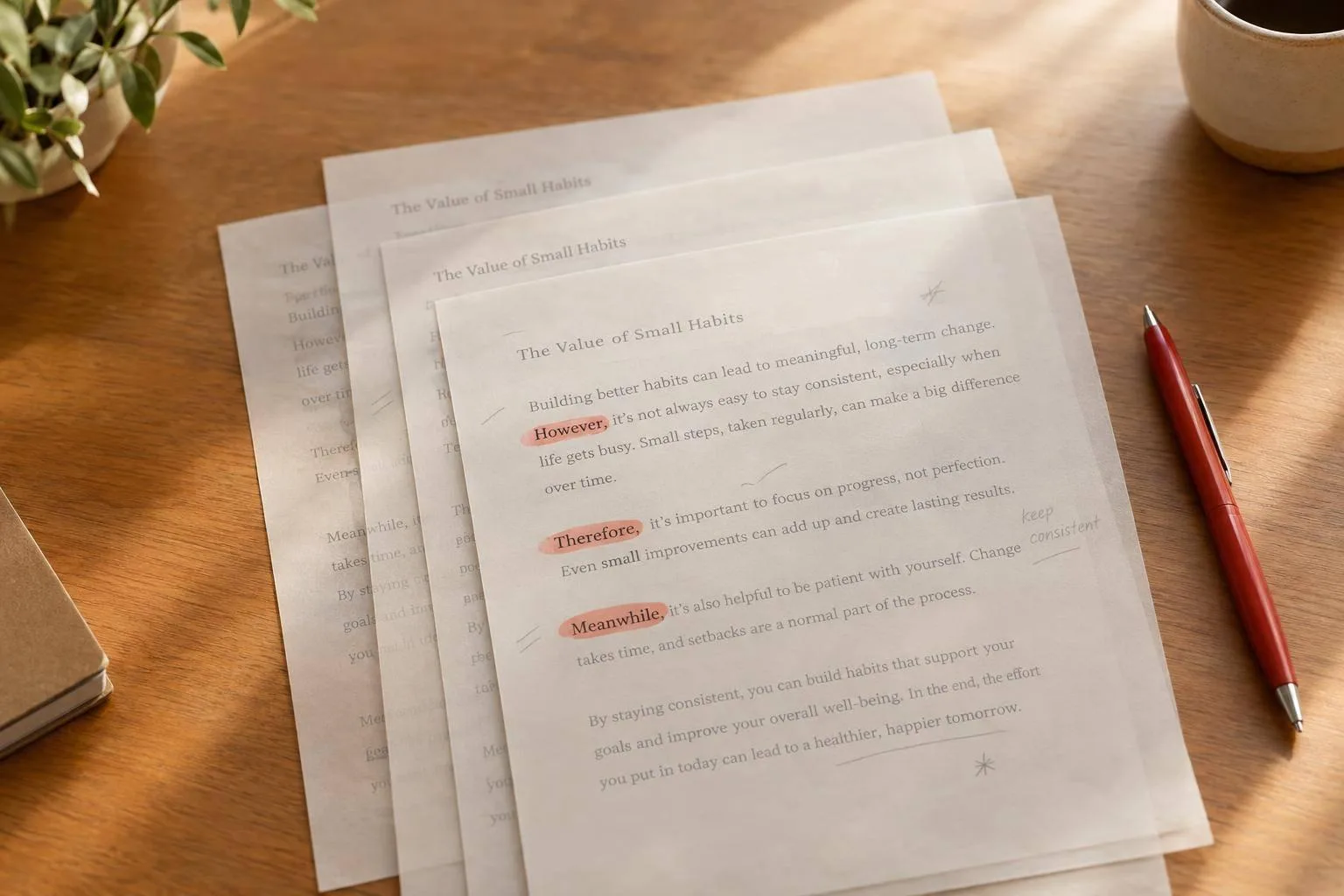
Repeated transition words can sound robotic, but they don’t prove AI use. Cut connectors that add nothing, vary sentence openings, and keep words that explain cause, contrast, or sequence.
A detector’s “70% AI” score is not a 70% chance that AI wrote the text. Writing habits, templates, and language background can produce similar patterns.
When authorship matters, review drafts, source notes, and revision history - not repetition alone. For editing, compare each rewrite with the original to check that facts and meaning stay intact. Treat tools such as UnslopAI as editing aids, not authorship tests.
When Do Transitions Sound Formulaic?
The problem isn’t the connector itself. It’s the pattern it creates. Transitions signal addition, contrast, sequence, cause, and conclusion. They sound formulaic when writers use them out of habit rather than need. Mechanical repetition - not formal wording - is the issue.
What Does Transition Overuse Look Like?
Hypothetical business email:
Furthermore, the marketing team reviewed the campaign results. Moreover, the team identified three audience segments. However, the current budget does not support all three segments.
Furthermore, the team recommends focusing on existing customers. Moreover, this approach could reduce acquisition costs. However, leadership approval is still required.
Both paragraphs follow the same addition–addition–contrast rhythm. That repeated pattern matters more than any single connector. “Furthermore” starts the email without an earlier point to build on. Several other connectors simply introduce the next fact.
No fixed count proves overuse or AI authorship. Assess each connector by what it does, the document’s length, and the audience.
Why Can Repetitive Writing Sound AI-Generated?
Predictable openings and repeated structures can resemble AI-style signposting. But that resemblance describes how the writing reads, not how it was written. Several everyday writing habits can produce the same effect.
| Pattern | Why it may sound formulaic | Common human explanations |
|---|---|---|
| Repeated transition openings | Makes the next sentence or paragraph predictable | Habitual phrases, workplace templates, academic outlines |
| Uniform sentence length | Strengthens the regular rhythm of repeated connectors | A report format or deliberate emphasis on clarity |
| Consistently neutral wording | Makes repeated connectors stand out against otherwise uniform language | Professional standards, legal caution, or an unfamiliar subject |
Writers using English as an additional language may lean on explicit connectors as they learn academic conventions. That habit isn’t evidence of AI use. Assessing authorship calls for context beyond repetition alone.
Why Can’t Transitions Prove AI Authorship?
Transitions alone cannot identify authorship. They need to be read in context: the genre, audience, purpose, and writer’s usual style. Short or tightly structured passages provide especially little evidence because they leave less room for individual phrasing.
A change from earlier work may call for review, but new requirements or editing could explain it. Detector scores can help guide that review. They cannot settle who wrote the text.
What Do AI Detection Scores Mean?
Detectors score patterns, not authorship.
A displayed “70% AI” is not a 70% probability of AI authorship.
Independent evaluations have found that detectors can classify the same text differently.[1][4] A score has meaning only if the detector’s method is documented and tested on similar texts.
False positives also vary with the writing being tested. A Stanford-associated study found that seven detectors misclassified an average of 61.22% of human-written TOEFL essays as AI-generated.[5] That rate applies to the study, not to all writing. Text type, language background, editing, paraphrasing, and translation can change results without changing authorship.[2][3][4]
The records behind the writing matter more than the score.
What Else Can Help Assess Authorship?
Review available drafts, revision history, source notes, and tracked changes. Ask the writer how the argument developed, which sources mattered, and why they made major revisions. Missing records do not prove misconduct. Legitimate writing often leaves only a partial trail.
Before judging any assistance, check the policy that applies to the school, workplace, freelance assignment, or application. Request only relevant records, respect privacy, and do not upload confidential work without permission. Use detector results to guide review, not accusation.
How Can You Reduce Repeated Transitions?
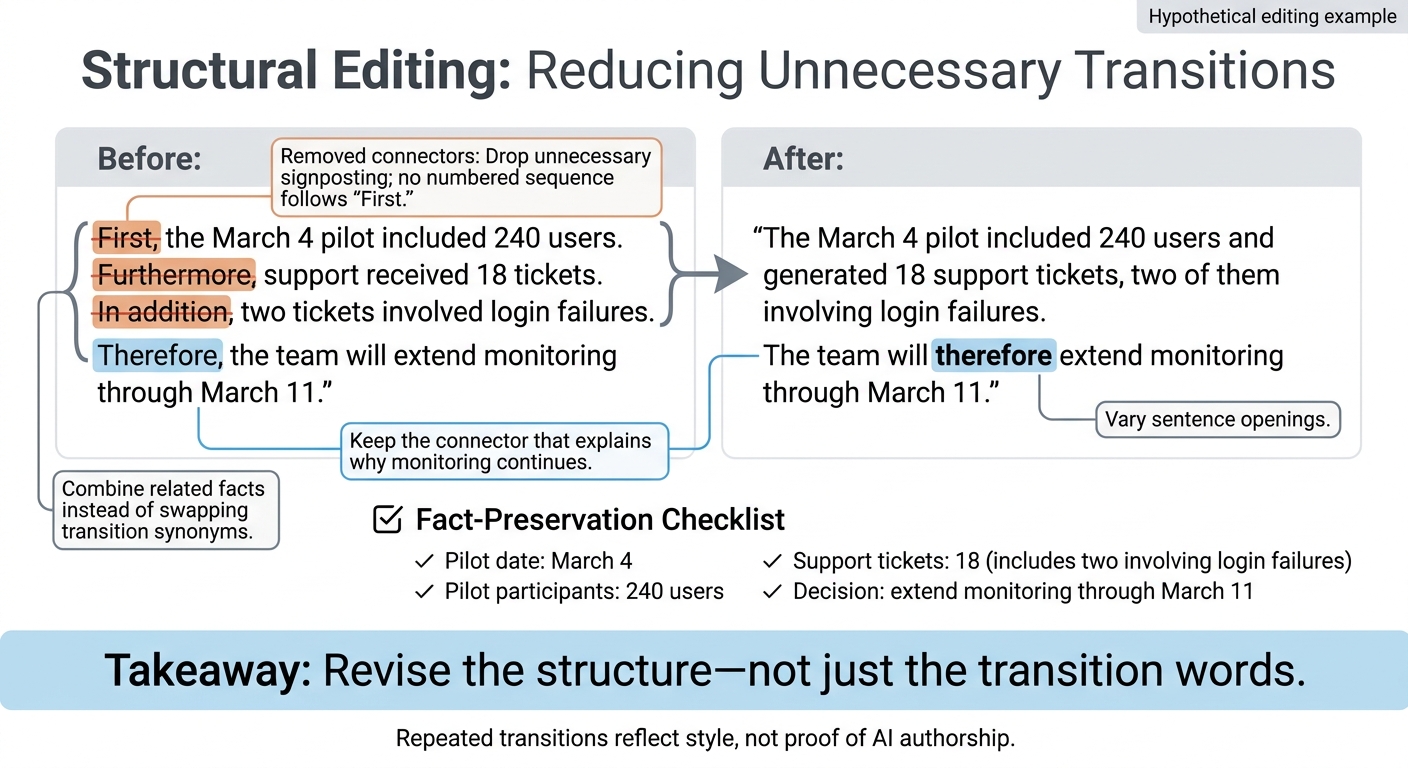
When repetition becomes a style problem, revise the structure - not just the transition words. Check each repeated connector. Keep it if it explains cause, contrast, sequence, or condition. Cut it if the sentence order already makes the connection clear. Replacing “Furthermore” with “Additionally” doesn’t fix the underlying repetition.
Which Edits Improve Flow Without Changing Meaning?
Hypothetical example - before: “First, the March 4 pilot included 240 users. Furthermore, support received 18 tickets. In addition, two tickets involved login failures. Therefore, the team will extend monitoring through March 11.”
After: “The March 4 pilot included 240 users and generated 18 support tickets, two of them involving login failures. The team will therefore extend monitoring through March 11.”
The revision combines related facts and varies sentence structure, so fewer sentences open with connectors. It drops “First” because no numbered sequence follows. But it keeps “therefore” to show that the pilot findings led to the decision.
For longer updates, put the main point first. Add connectors only where they help explain the logic. Read the text aloud to spot awkward pauses and cluttered sentences, then check that the facts and meaning haven’t changed. Here, the rewrite preserves both dates, all counts, and the decision to extend monitoring.
How Can UnslopAI Help With Revision?
For a faster editing pass on an AI-polished draft, compare the original with the rewrite.
UnslopAI rewrites AI-polished drafts while preserving meaning. Its before-and-after diffs show which connectors and sentence structures changed. Check the fidelity review against the original, and treat slop scoring as editing feedback - not proof of authorship.
Conclusion: Repeated Transitions Reflect Style, Not Authorship
Repeated transitions reflect style, not authorship. Human writing habits and genre expectations can produce the same patterns found in AI-written drafts. Assess what repetition does, not just how often it appears.
When authorship matters, check drafts, source notes, and revision history. Don’t rely on a detector score alone.[6]
Cut unnecessary connectors and rework repetitive sentences without losing facts, qualifications, or your own voice. Write for clarity, not detector scores, by writing with AI without sounding like it.
FAQs
How can I spot repetitive patterns in my own writing?
Read your draft aloud to hear where the rhythm feels stiff. Watch for repeated sentence openings, similar clause structures, and paragraphs that end by repeating the point. Check whether sentence lengths vary and flag generic lines that lack specific names, numbers, or dates.
UnslopAI’s before-and-after diffs and slop scoring can help you spot these patterns and adjust the rhythm without changing your meaning.
What should I do if my writing is falsely flagged as AI?
Don’t treat the result as a final judgment. Detectors can be inconsistent and may mistake structured, precise, or technical human writing for AI-generated text.
Read your draft aloud to spot stiff phrasing. Swap generic wording for your own vocabulary and concrete details without changing your meaning, level of certainty, or facts. Use UnslopAI’s before-and-after diffs to review edits, keeping your voice and perspective first.
When do readers need more explicit transitions?
Readers usually need explicit transitions only when the link between ideas is unclear or the logic needs a bridge. If the contrast or progression is already clear, cut the transition to keep the writing direct and natural. Use a transition to flag a downside or show that events happen at the same time only when the context doesn’t make that connection clear.