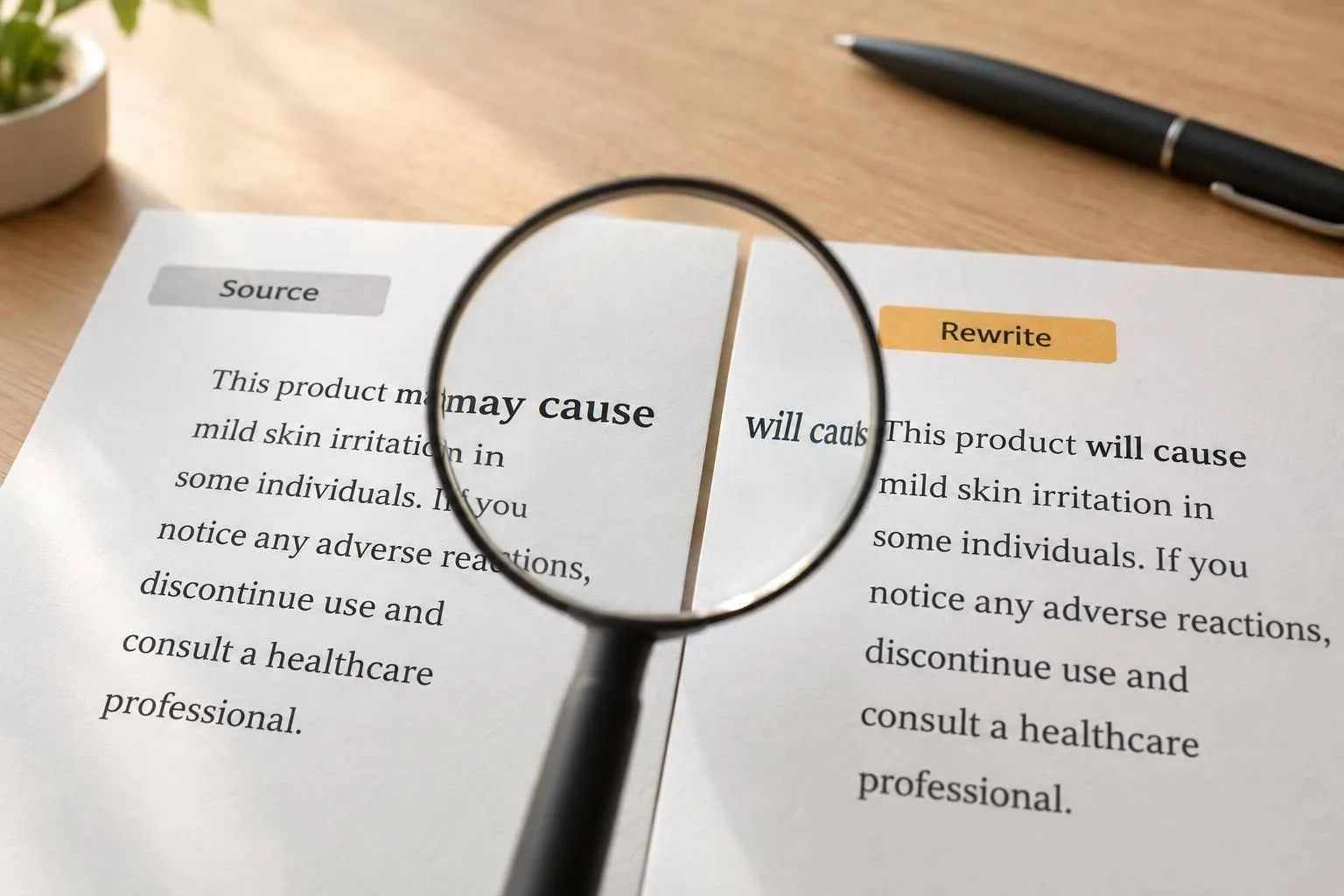
Yes - specific details can change what an AI rewrite says, not just how it sounds. Changing “many” to “62%” adds a factual claim. Changing “may improve” to “improves” removes uncertainty. Check every added detail against the source before keeping it.
A faithful rewrite preserves:
- Scope: who the claim covers, when it applies, and how much it describes.
- Certainty: qualifiers, conditions, exceptions, and who made the claim.
- Cause: whether the source reports a link or establishes cause and effect.
Compare each rewritten claim with its source, then check facts and meaning separately. If support is missing, leave the detail out or flag it for review. Even a verified addition may need approval as a content update - not a style edit. Review tools can help spot changes, but they do not replace source checks. You can also test your detection skills to see how subtle these shifts can be.
When Details Change a Claim
Scope, Timing, and Quantity
A rewrite can change a claim by adding a detail the source never gave. This is a common challenge when writing with AI for professional use cases.
Examples: Some users becoming first-time users narrows the claim to a subgroup. Replacing recently with in March 2026 sets a precise time boundary; replacing many with 62% turns a broad quantity into a new factual claim.[2][3]
These edits change scope, not just style. Check that the source supports the population, time period, and quantity. A percentage needs a clear base and method. Even a detail verified elsewhere is still an addition unless the task allows outside information. Verification alone does not make it a faithful restatement.[2][3]
Certainty, Attribution, and Conditions
Small edits can change how certain a claim sounds, who made it, or when it applies.
Examples: The feature may improve response times leaves the result uncertain; the feature improves response times presents it as established. If the source attributes the claim to the founder, keep the attribution. Changing the proposal could reduce costs if approved to the proposal will reduce costs removes both uncertainty and a condition.[2][3][4][6]
Keep qualifiers such as might, estimated, proposed, in some cases, and subject to approval. Preserve negation and exceptions, too.[2][3][4][6]
Causes, Explanations, and Study Groups
Association does not establish causation. A relationship may reflect confounding, reverse causation, or chance. Keep the source’s causal wording, and don’t add an untested mechanism. Study limits also matter: changing the population, time span, or causal wording changes what the claim supports.[7][8][9]
Examples: Rewriting higher exercise levels were associated with lower reported stress as exercise caused lower stress adds a causal conclusion; explaining it through changed hormone levels adds an unmeasured mechanism. If a trial followed 300 adults for four weeks, rewriting Participants reported fewer errors as All customers make fewer errors broadens the population. Keep the finding tied to the study group and observation period.[1][2][5]
If a rewrite changes scope, certainty, or cause, check it against the source before keeping it. Next, match each rewritten claim to the source line by line.
Check Rewritten Claims Against the Source
A rewrite can sound faithful yet change a claim’s scope, certainty, or attribution. If you are automating these checks, you can integrate our API reference into your workflow.
Match Each Claim to Source Text
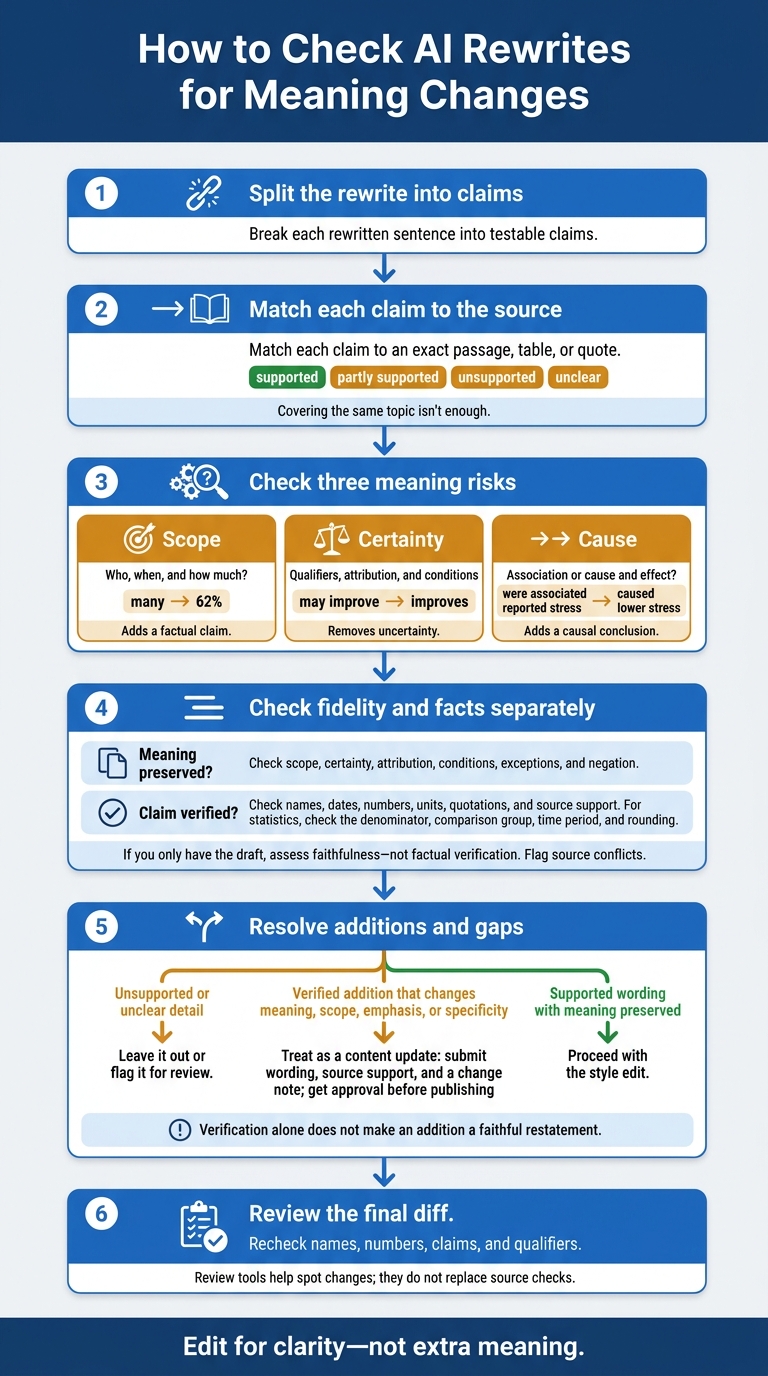
Break each rewritten sentence into testable claims. Match each one to an exact passage, table, or quote in the draft or supplied sources. Mark it supported, partly supported, unsupported, or unclear. Covering the same topic isn’t enough to support a new claim.
Check meaning preserved and claim verified separately. If you only have the draft, assess whether the rewrite stays faithful - not whether the facts are verified. If the evidence contradicts the draft, flag the conflict.
Do this before editing the wording so each revision stays tied to its source.
Compare Risky Changes in a Table
A side-by-side check helps you spot changes that might otherwise slip through. These hypothetical examples use only the supplied wording.
Source wording Rewritten wording Change introduced Supported by source? “The survey included a customer group in Texas.” “The survey included all U.S. customers.” Expands the population and geography. No - only the Texas group is supported. “About 8% of respondents reported using the feature.” “8% of customers use the feature.” Removes approximation and self-reporting; changes the denominator. No - the wording supports respondents’ reports, not all customers’ behavior. “Users who enabled reminders completed more tasks.” “Reminders caused users to complete more tasks.” Adds a causal conclusion. No - the wording does not establish cause.
Verify Facts and Qualifiers
Check names, product names, dates, numbers, units, identifiers, quotations, and speakers’ stated positions directly against the source. For statistics, check the denominator, comparison group, time period, and rounding. Review attribution, certainty, prerequisites, exceptions, and negation separately.
Use U.S. formatting without changing meaning. Dates, numbers, and units can change how readers understand a claim. Use commas for thousands and periods for decimals.
Write a verified date as March 5, 2026, but never guess whether 03/05/2026 means March 5 or May 3.
Convert units only when the conversion is exact. Otherwise, keep the source unit. If a detail is uncertain, keep its source form until it’s confirmed.
Rewrite Naturally Without Adding Facts
Edit the phrasing, not the facts. Keep the same subject, action, and claim strength. More specific wording isn't more accurate.
Verify the source, then tighten the wording without broadening the claim.
Preserve Uncertainty When Facts Are Missing
Keep wording general when the source provides no further detail, and preserve qualifiers that affect meaning. Remove unsupported additions or flag the gap for review. If a missing detail changes the meaning, say that the source doesn't specify it. Hedging an invented detail doesn't make it supported.[12]
Follow a Source-First Rewrite Process
If a verified addition changes meaning, scope, emphasis, or specificity, treat it as a content update, not a style edit. Submit the proposed wording, source support, and a brief note explaining what changed. Get approval before publishing so style edits don't become factual changes.
Review Changes With UnslopAI
Use UnslopAI to review before-and-after diffs for names, numbers, claims, and qualifiers. Watch for added specifics and deleted qualifiers. A shorter draft can still lose limits that matter.[10][11] Use it as a review checkpoint - not a replacement for source comparison and judgment - to catch lost qualifiers before finalizing the draft.
Conclusion: Add Only Supported Details
Added details can narrow the scope, increase certainty, remove conditions, or turn a link into a cause-and-effect claim.
Before publishing, check every added detail against the source. Keep attribution, uncertainty, and limits intact.
If the source doesn’t support a detail, leave it out or get confirmation and approval before adding it. Edit for clarity - not extra meaning.
FAQs
How can I tell if added detail changes my claim?
Compare the source and AI rewrite side by side. Check whether the rewrite changes who said what, how broadly a claim applies, or how certain it sounds. Keep qualifiers like “could,” “may,” and “up to” - don’t turn possibilities or limits into guarantees. Check any added numbers, names, and dates against the source, not the draft.
UnslopAI’s before-and-after diffs and fidelity checks can help flag additions. Treat them as review aids, not proof of accuracy.
How do I check fidelity when sources conflict?
Put original source material first - not the AI draft. Manually check names, figures, dates, and claims against an authoritative source. Don’t rely on the AI’s version or automated fidelity checks.
If internal documents conflict, flag the mismatch and confirm which fact or preference takes priority before moving forward. Keep uncertainty intact: don’t make claims stronger or settle ambiguities beyond what the evidence supports.
How can I preserve uncertainty without sounding vague?
Keep the source’s qualifiers, including “may,” “could,” “about,” and “subject to approval.” Don’t turn possibilities into promises. When evidence is limited, make that uncertainty clear rather than smoothing it over for flow.
If a draft makes a broad claim without supporting facts, don’t fill in the blanks. Flag the missing support as a gap or remove the claim to stay accurate to the source.