I make AI writing more specific by replacing vague claims with facts I can check - not by adding words. That means naming who acted, defining limits, and keeping measured results separate from possible causes.
These six edits show how I:
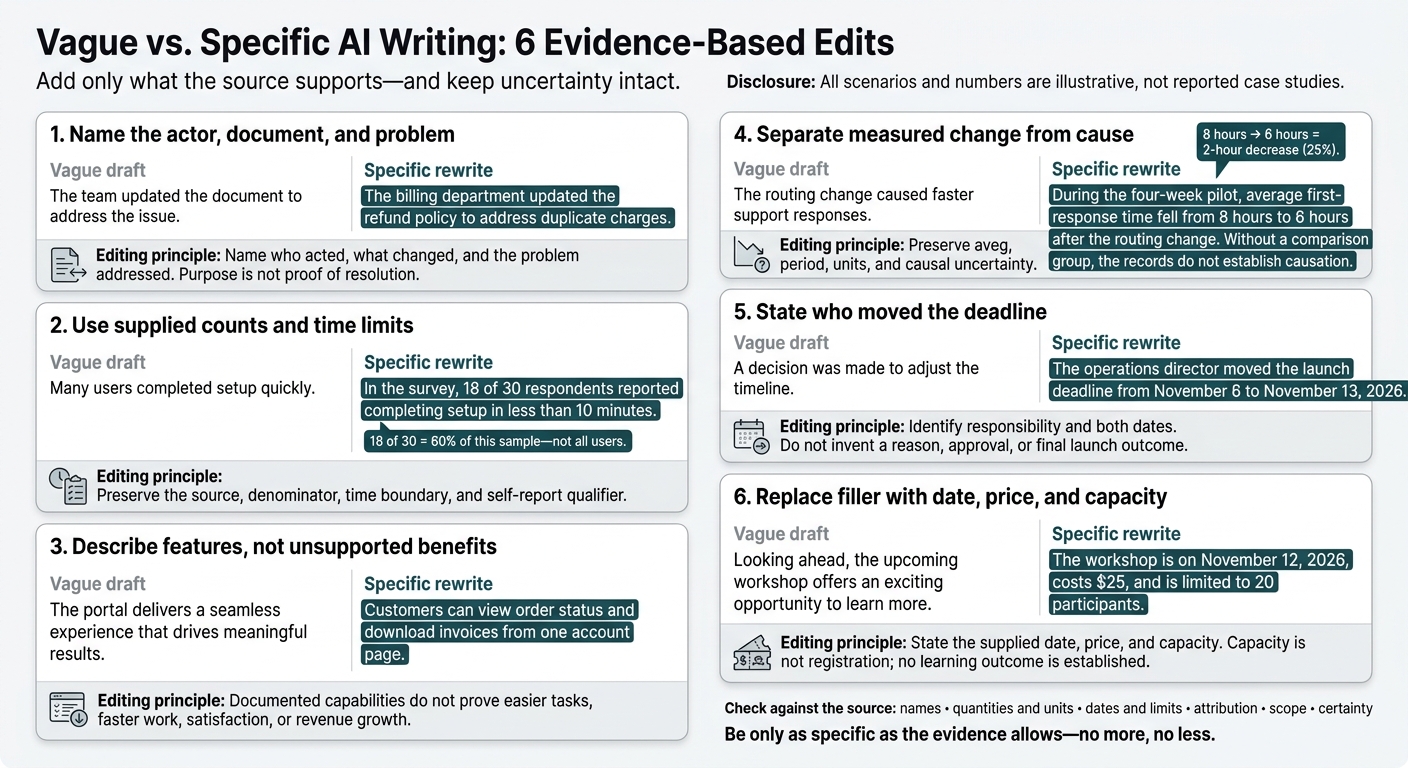
- Name the actor, document, and problem.
- Use counts and time limits: 18 of 30 respondents means 60% of that sample, not all users.
- Describe features without promising unsupported benefits.
- Separate change from cause: a drop from 8 hours to 6 hours is 25%, but it doesn’t prove why response times fell.
- Identify who moved a deadline and give both dates.
- Replace filler with the date, price, and capacity.
All examples are illustrative. My rule throughout: add only what the source supports - and keep uncertainty intact.
How to Read the Comparisons
Treat each comparison as an edit bounded by its source. Every added detail must come from the supplied facts. Unsupported details must stay qualified or be removed. The focus is on changes in meaning, not just wording.
Read in four steps: supplied facts, vague draft, specific rewrite, and annotations. All scenarios and numbers are illustrative, not reported case studies.
The Supplied facts - illustrative note above each table sets the edit’s limits. Read the full Vague draft and Specific rewrite side by side to assess the whole claim - not just individual word choices.
Diff notes pair deleted wording with replacement wording. They show where the edit names something precisely, limits a claim, or adds a supplied fact.
What changed explains the effect for the reader: clearer responsibility, a defined time window, or a measured result kept separate from its possible cause.
Fidelity check ends each comparison with Pass, Pass with clarification needed, or Fail - unsupported addition. Check names, figures, dates, attribution, scope, and certainty against the supplied facts. Don’t turn an unsupported explanation into a fact.
Use this approach as you read the first comparison.
1. Name the Actor, Document, and Problem
Supplied facts - illustrative: The billing department updated a refund policy to address duplicate charges.
Vague draft: The team updated the document to address the issue.
Specific rewrite: The billing department updated the refund policy to address duplicate charges.
Diff notes: The team → The billing department names who acted. the document → the refund policy identifies what changed. the issue → duplicate charges names the problem so readers don’t have to guess.
What changed: Three noun substitutions answer who, what, and why in the same sentence. The verb updated stays: the facts don’t establish that the department replaced or fully rewrote the policy. When editing, check broad nouns first rather than adding another sentence.
Fidelity check: Pass. “To address duplicate charges” states the update’s purpose - not its result. The rewrite does not claim that the charges stopped, refunds were issued, or the problem was resolved.
2. Use Supplied Counts and Time Limits
Supplied facts - hypothetical: In the survey, 18 of 30 respondents reported completing setup in less than 10 minutes.
Vague draft: Many users completed setup quickly.
Specific rewrite: In the survey, 18 of 30 respondents reported completing setup in less than 10 minutes.
Diff notes: Replacing “Many” with 18 gives the count. Changing “users” to of 30 respondents defines the surveyed group and denominator. Replacing “quickly” with in less than 10 minutes adds a measurable time limit. “In the survey” names the source, while “reported” makes clear that respondents supplied the information.
What changed: Readers can judge the claim’s size and scope. The count equals 60%, but that percentage applies only to this sample.
Fidelity check: Pass. The rewrite preserves the count, time boundary, and self-report qualifier. If the source gives only a range, keep that range.
Respondents reported setup times between 8 and 12 minutes.
3. Describe Features Instead of Unsupported Benefits
Supplied facts - hypothetical: Product documentation states that customers can view order status and download invoices from one account page.
Vague draft: The portal delivers a seamless experience that drives meaningful results.
Specific rewrite: Customers can view order status and download invoices from one account page.
Diff notes: Cut “seamless experience,” an unmeasured usability claim, and “drives meaningful results,” an unsupported outcome claim. The rewrite names “Customers” as the actor, identifies “view order status” and “download invoices” as observable capabilities, and gives “from one account page” as the documented location.
What changed: Readers can see what the portal does. That doesn’t prove either task is easier or faster.
Fidelity check: Pass. The rewrite adds no claims about satisfaction, revenue growth, or time savings. Claims such as “frictionless,” “boosts sales,” or “saves time” need evidence.
Next, the focus shifts from features to measured change. This transition is a core part of writing with AI without losing human precision.
4. Separate Measured Changes From Causes
Supplied facts - hypothetical: Records cover a four-week support-routing pilot with no comparison group. Average first-response time fell from 8 hours to 6 hours.
Vague draft: The routing change caused faster support responses.
Specific rewrite: During the four-week pilot, average first-response time fell from 8 hours to 6 hours after the routing change. Without a comparison group, the records do not establish causation.
Diff notes: “Four-week pilot” sets the observation period. “Average first-response time” names the metric. “8 hours to 6 hours” gives the baseline, endpoint, and unit: a 2-hour decrease, or 25%. Using “after” instead of “caused” describes the order of events without claiming that one caused the other.
What changed: The rewrite keeps the measured drop but removes the unsupported explanation. You can automate these edits using our API reference.
Fidelity check: Pass. Keep “average”: the records do not show that every ticket received a faster response.
5. State Who Moved the Deadline
Supplied facts - hypothetical: Meeting notes say the operations director moved the launch deadline from November 6 to November 13, 2026.
Vague draft: A decision was made to adjust the timeline.
Specific rewrite: The operations director moved the launch deadline from November 6 to November 13, 2026.
Diff notes: “The operations director” names who acted. “Moved” replaces an impersonal phrase with a direct verb. “The launch deadline” states what changed. And “from November 6 to November 13, 2026” gives both dates instead of leaving readers with an unspecified timeline adjustment.
What changed: Readers can see who acted and how the deadline shifted. Use the role listed in the notes - don’t invent a name.
Fidelity check: Pass. The rewrite reports the action without adding a reason, executive approval, or a launch outcome. It doesn’t claim November 13 was final.
Next, see how filler turns into dates, prices, and capacity.
6. Replace Filler With Date, Price, and Capacity
Supplied facts - hypothetical: The workshop is on November 12, 2026, costs $25, and holds up to 20 participants.
Vague draft: Looking ahead, the upcoming workshop offers an exciting opportunity to learn more.
Specific rewrite: The workshop is on November 12, 2026, costs $25, and is limited to 20 participants.
Diff notes: Cut “Looking ahead” and “upcoming” because neither tells readers the date. Remove “exciting opportunity” because the enthusiasm has no support, and “to learn more” because it names no learning outcome. Replace that filler with the brief’s date, price, and capacity.
Check every date, price, and capacity claim against the brief.
Fidelity check: Pass. The rewrite states capacity - not registration - and makes no promise about outcomes.
Final Check: Keep Details Supported
Before publishing, check the rewrite for details the source doesn’t support.
Compare it with the source - not just the vague draft. Check every factual claim: What does it assert, and what supports it?
Names and responsibility: Check who the source says acted, what changed, and which problem the change addressed. If responsibility is unknown, leave it unknown.
Numbers and boundaries: Match quantities, units, dates, time frames, prices, and limits to the source. Keep all qualifiers and sample boundaries.
Features, outcomes, and causes: State what the product does or what the evidence measured. Use caused, led to, and because only when the source supports causation.
Keep uncertainty intact. Be only as specific as the evidence allows - no more, no less. Cut or qualify anything the source doesn’t support.
FAQs
How do I improve vague text when source details are missing?
Replace vague claims with firsthand details: what you experienced, what happened, or where you stand. If you can’t back up a broad claim with a concrete name, date, or number, it probably doesn’t belong in your draft. Cut it. Your own judgment carries more weight than generic praise and gives the writing a more human voice.
When does added detail make writing harder to read?
Details help readers check what you write. But packing too many claims into one sentence makes it harder to read. Use numbers, names, and dates to ground your writing, and separate claims so readers can check each one on its own. If a sentence tries to do too much, trim it or split it into shorter sentences.
How can I spot meaning changes in an AI rewrite?
Compare the original and rewritten text side by side. Look for changes in claims, scope, attribution, certainty, and ownership. Check numbers, dates, names, and qualifiers - for example, whether “up to 30%” became “30%.”
UnslopAI’s before-and-after diff highlights additions and strikes through removals [1]. Verify details independently. Automated checks can help you review changes, but they don’t prove accuracy [1][2].