
I use weighted slop scoring to decide what to edit first - not to detect AI writing. I rate writing issues from 0 to 4, multiply each rating by its weight, and add the results. A score of 2.4 equals 60 out of 100.
Here’s what I check:
- Stock wording
- Flat sentence rhythm
- Repeated openings and clause patterns
- Formulaic transitions and paragraph shapes
- Incorrect names, numbers, or claims
I set weights that total 100%, then tackle the issues with the most weighted points. After editing, I check the meaning and score again using the same rubric.
The rule I follow: a lower score is only useful if the draft stays accurate and sounds natural. It’s an editing guide, not a universal grade.
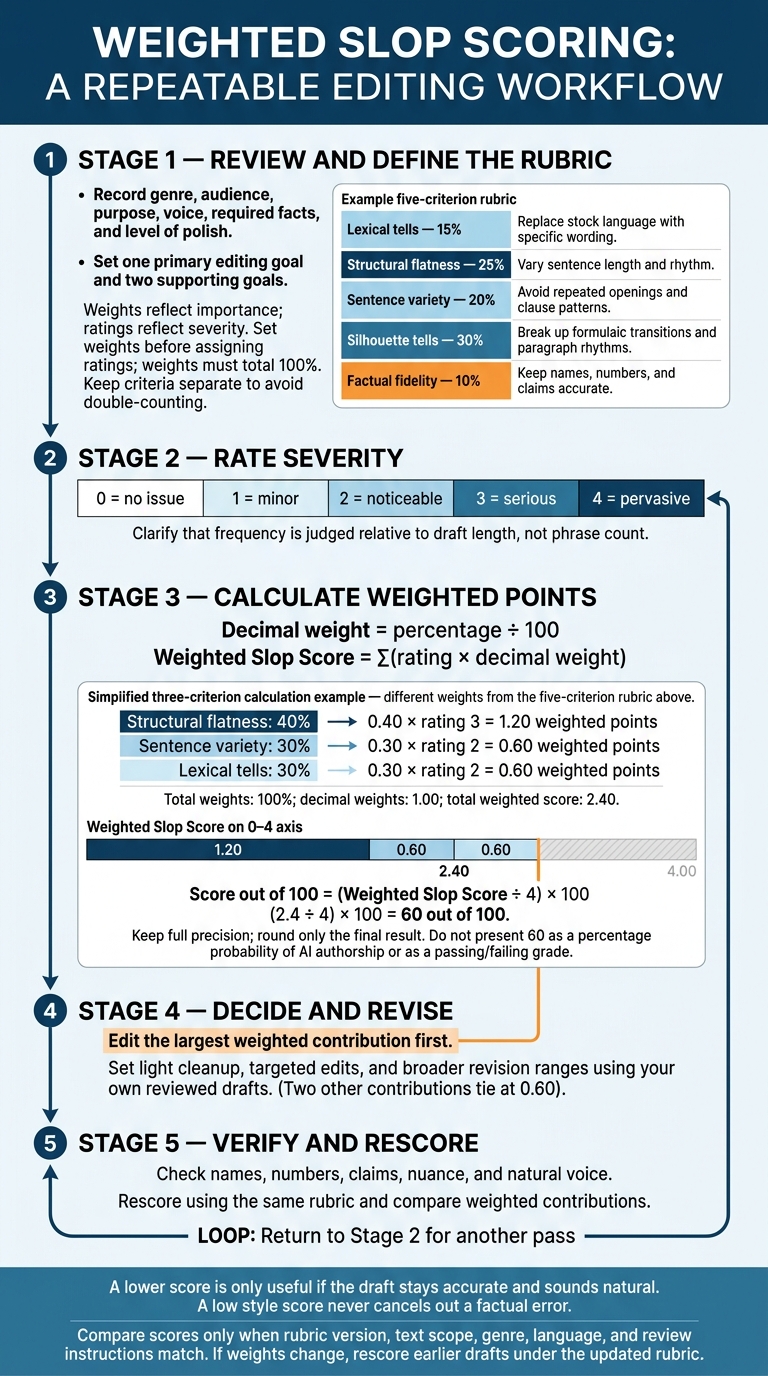
1. Review the Draft and Set Scoring Criteria
Record the draft’s genre, audience, purpose, voice, required facts, and level of polish. Before scoring, set one primary editing goal and two supporting goals.[6]
Judge the draft against its purpose and where it’s most likely to fall short. A customer email and a formal business proposal need different levels of polish, structure, and detail.
Choose Separate Writing Criteria
Keep criteria separate so you don’t count the same issue twice. Score an issue under two criteria only when it affects the reader in two different ways.
Set Weights and Define the 0–4 severity scale
Weights reflect importance; ratings reflect severity. Set weights before assigning ratings. That keeps them tied to the document’s purpose, not your reaction to a particular sentence. The example weights below give overall structure more weight than individual word choice.[7]
Use 0 = no issue, 1 = minor, 2 = noticeable, 3 = serious, and 4 = pervasive. These weights total 100%. The descriptions show what each score looks like, making the scale easier to apply consistently.
| Criterion and editing action | Weight | 0: No issue | 2: Noticeable | 4: Pervasive |
|---|---|---|---|---|
| Lexical tells: Replace stock language with specific wording. | 15% | Language sounds natural and specific. | Familiar phrases appear often enough to stand out. | Stock phrasing drives the draft. |
| Structural flatness: Vary sentence length and rhythm. | 25% | Sentence rhythm feels natural. | Several stretches feel mechanically uniform. | Uniform structure defines the passage. |
| Sentence variety: Avoid repeated openings and clause patterns. | 20% | Openings and clause order vary naturally. | Repeated patterns start to feel predictable. | Repeated patterns dominate the draft. |
| Silhouette tells: Break up formulaic transitions and paragraph rhythms. | 30% | The overall shape feels organic. | A few transitions or recaps feel too predictable. | The document follows a rigid, formulaic shape. |
| Factual fidelity: Keep names, numbers, and claims accurate. | 10% | Facts are correct. | A few details need verification. | Errors or misstatements undermine the draft. |
Use 1 for isolated issues and 3 for recurring issues that disrupt reading without dominating the draft. Judge frequency in relation to draft length, not just phrase count.
Treat factual fidelity separately: a low style score never cancels out an incorrect name, number, or claim. Once the criteria and weights are fixed, score each criterion and add up the weighted points.
2. Calculate the Weighted Score
Once you’ve set the criteria, combine the ratings into a single score using the rubric’s weights.
Weighted Slop Score = Σ(rating × decimal weight), where decimal weight = percentage ÷ 100. If ratings range from 0 to 4 and decimal weights add up to 1, the score stays between 0 and 4.
Calculate Each Criterion’s Weighted Points
Multiply each criterion’s rating × decimal weight, then add the weighted points.
Criterion Percentage weight Decimal weight Raw rating (0–4) Weighted points Structural flatness 40% 0.40 3 1.20 Sentence variety 30% 0.30 2 0.60 Lexical tells 30% 0.30 2 0.60 Total 100% 1.00 ** - ** 2.40
The total is 2.40. Keep full precision throughout the calculation and round only the final result.
Convert the Score to a 0–100 Scale
Score out of 100 = (Weighted Slop Score ÷ 4) × 100.
(2.4 ÷ 4) × 100 = 60 out of 100.
Use this percentage to compare drafts scored with the same criteria and weights. Use the final number to rank the biggest edit targets.
3. Use the Score to Plan Edits
Build ranges for the 0–100 score using your own reviewed drafts, not universal cutoffs. Group drafts by genre, formality, and voice. Then label them as light cleanup, targeted edits, or broader revision, and use those labels to set ranges for each format.
Once you’ve set the ranges, start with the criterion that contributes the most weighted points.
Address the Largest Weighted Contributions First
Find the passages driving that criterion’s score and edit those first. A middle score usually calls for light cleanup, such as cutting filler phrases and repetitive transitions [3][6].
Re-score the Draft and Verify Meaning
Score the edited draft again using the same rubric. Keep a comparison record, and fill in the revised columns only after reading the edited draft. Use the changes in weighted points to guide your next editing pass.
| Criterion | Original rating | Original weighted points | Revised rating | Revised weighted points |
|---|---|---|---|---|
| - | - | - | - | - |
| Total | ** - ** | ** - ** | ** - ** | ** - ** |
If you use UnslopAI, use its diff view and fidelity checks to compare revisions and spot shifts in meaning. Check names, numbers, and claims before publishing [1][5].
4. Keep Scoring Consistent
When multiple reviewers score drafts, lock the rubric before comparing results. Compare scores only when the rubric version, text scope, genre, language, and review instructions match. Reviewers also need the same guidance on tone, length limits, and structural priorities - not just the same scoring sheet.
Resolve Differences Between Reviewers
Ask reviewers to score the same set of drafts independently before discussing results. Compare each criterion’s 0–4 ratings, not just the totals. When ratings differ, have each reviewer point to the passages that support their score. Clear up any ambiguous rating anchors, then rescore the shared drafts.
Check whether criteria overlap and document which criterion covers each issue. Store these decisions with the rubric so future reviewers follow the same rules.
Track Changes to Criteria and Weights
Once reviewers agree on the rubric, change weights only when the editing goal changes. To test a proposed change, increase one weight, rebalance the others to total 100%, and recalculate the scores using the existing ratings. Check whether the largest weighted contributions shift as intended.
Save each rubric version with its criteria, rating definitions, weights, reason for the change, and scoring history. Before comparing past and current results, rescore the earlier drafts under the updated rubric with matching review conditions. Otherwise, a score change may reflect a different measuring system - not better writing.
Conclusion: Repeat the Review, Score, and Edit Cycle
Weighted scoring ranks edits by impact. Lower scores matter only if the meaning stays intact.
Use the same loop for every draft: score, revise, verify, and rescore.
- Review: Check the draft for flat rhythm, repetition, and other flagged patterns.
- Score: Apply the rubric and weight each rating by importance.
- Decide and revise: Tackle the biggest weighted issues first. Cut filler, vary rhythm, and preserve meaning. Compare versions to check names, numbers, claims, and nuance. [1][2]
- Re-score: Use the same rubric to score the draft again, then decide whether it needs another pass. [5]
Keep the rubric consistent across passes, checking that each edit keeps the draft natural, accurate, and closer to the intended voice.
FAQs
How do I choose weights for my first draft?
Treat the slop score as a diagnostic flag, not a final judgment [1]. Start with burstiness to check for repetitive sentence lengths. Then use sentence variety metrics to spot repeated openings or clause patterns [1]. Give more weight to metrics tied to your goals, whether that’s better rhythm or less filler [1][2]. Use UnslopAI’s before-and-after diffs to fine-tune those weights, checking that edits keep your voice and facts intact [1][3][4].
How do I distinguish flat rhythm from repetitive syntax?
Use burstiness to check sentence-length variation, and look at sentence variety to assess flow. Length alone doesn’t tell the whole story. Writing can still feel repetitive when sentences use predictable openings, repeat the same clause order, or rely on formulaic transitions. If burstiness points to a flat rhythm, check for those patterns.
UnslopAI’s side-by-side diffs help you see whether a rewrite swaps repetitive elements for a more natural cadence and structure.
When should I stop editing, even if my score isn't zero?
Stop editing when your draft sounds like you, even if the slop score is still above zero [1][2]. Chasing zero can erase your natural rhythm. Human writing often includes words or patterns that AI models flag [2].
Keep your original meaning and facts intact. Leave small imperfections if fixing them would change your message [2]. Treat the score as a guide, not a demand for perfection [1][3].