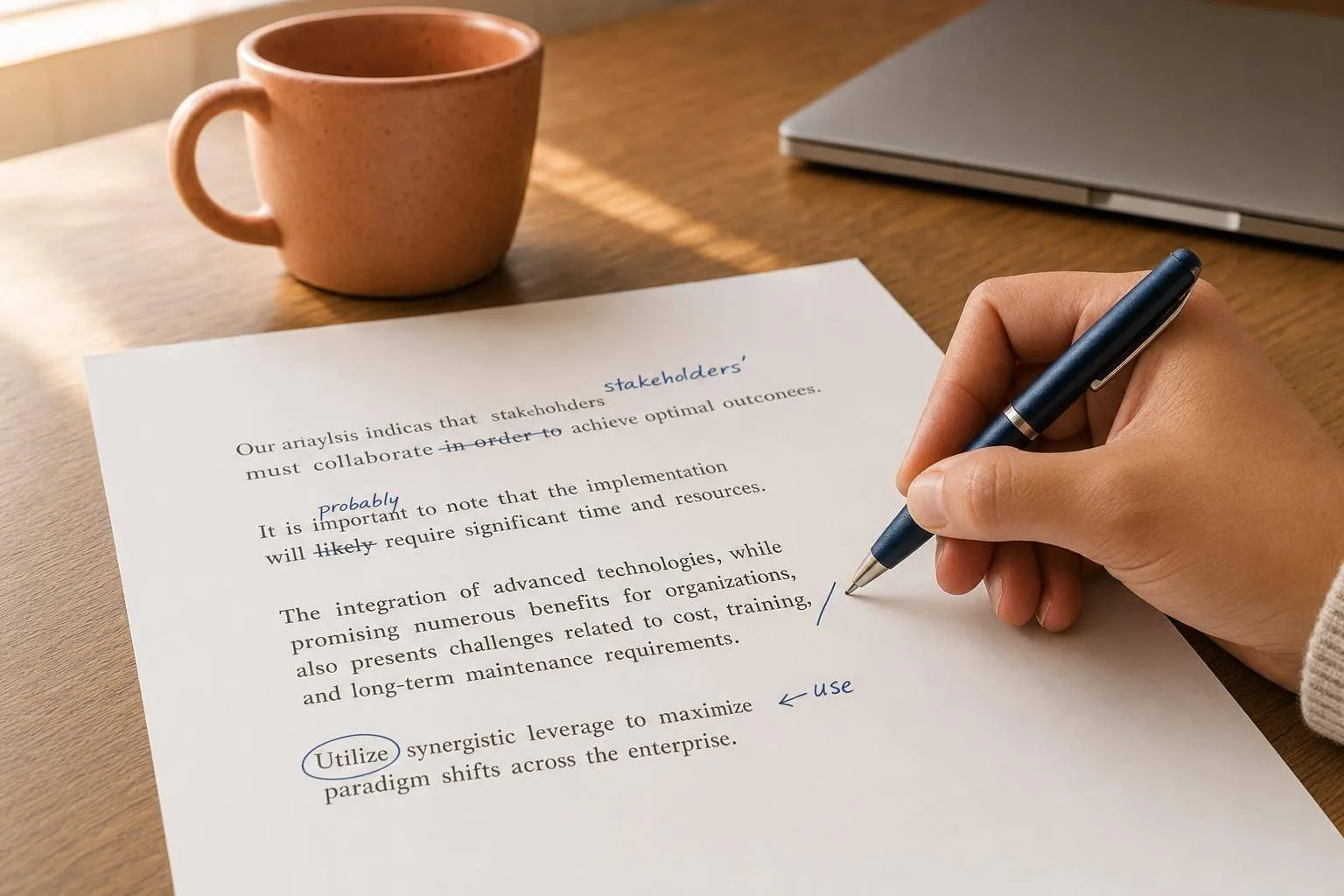
A polished AI draft can still feel cold. In most cases, I see the same 4 causes: it skips contractions, leans on filler phrases, repeats the same sentence rhythm, and swaps plain words for safer ones.
If you want to fix it, I’d do this in order:
- Add contractions where the tone allows
- Cut filler openers and get to the point faster
- Vary sentence length so you can spot the AI less easily in the draft
- Pick plain, direct words instead of formal ones
That’s the whole idea: keep the meaning the same, but make the draft sound like a person wrote it.
A few quick examples:
- “We do not recommend this approach” → “We don’t recommend this approach”
- “It is important to note that…” → Cut it
- “We will leverage automated validation…” → “We’ll use automated checks…”
- “Utilize” → “Use”
Why does this matter? Because even if a draft is 100% grammatically clean, people can still feel the distance in the tone. The words may be right, but the voice feels flat.
Here’s the short version:
| Problem | What it does | Simple fix |
|---|---|---|
| No contractions | Sounds formal and distant | Use “don’t,” “we’ll,” “you’re” |
| Filler phrases | Slows the point | Cut warm-up lines |
| Even cadence | Feels robotic | Mix short and long sentences |
| Safe word choice | Sounds generic | Use plain, direct words |
I’d sum it up like this: AI polish often improves correctness but hurts flow. The fix isn’t to make the draft messy. It’s to make it sound natural again.
5 Edits That Instantly Make AI Text Sound Human
Problem 1: Full Forms Make Writing Sound Formal and Distant
AI often leans toward formal, middle-of-the-road prose. That happens because training and reward tuning tend to favor polished writing over the way people actually sound on the page.
How missing contractions shift the tone
In most U.S. digital writing - blogs, emails, LinkedIn posts, and creator content - contractions are the norm [2]. When they disappear, the writing can feel colder and more distant.
| Stiff AI Pattern | Human-Tuned Fix |
|---|---|
| "We do not recommend this approach" | "We don't recommend this approach" |
| "You are going to find..." | "You'll find..." |
| "We do not need to repeat this" | "We don't need to repeat this" |
| "We have significantly reduced the time" | "We've significantly reduced the time" |
That's why a contraction pass is one of the fastest ways to make a draft sound more human.
How editors add contractions without going too casual
Go through the draft and switch full forms to contractions when the audience and format allow it. In most digital settings, that includes blogs, emails, LinkedIn posts, and creator content [2].
Keep full forms when you want extra emphasis or when the line is a warning, like "Do not enter."
Then read the piece out loud. If a sentence sounds stiff, tighten it with a contraction or rewrite it in a more direct way. But contractions alone won't fix everything. Safe wording can still drain the voice.
Problem 2: Safe Phrasing and Even Cadence Flatten the Writing
Contractions help, but a draft can still land with a thud. The usual culprit is phrasing and rhythm. You’ll often spot it first in the opening line or in the transitions between ideas.
Generic phrases erase the writer's voice
AI drafts tend to fall back on stock openers and transitions - lines like "It is important to note" and "Furthermore." They’re safe. They’re clean. And they drain the voice right out of the page.
Editors usually fix this by cutting the warm-up and leading with the point itself. "Building a content strategy takes real planning" says the same thing without the padding.[2] The same fix applies to stiff connectors. "Furthermore" can often turn into "And", "But", or just disappear.
Uniform sentence length makes a draft feel robotic
Rhythm causes the same kind of drag.
AI often repeats the same sentence shape again and again, which makes the prose feel mechanical. Mix up sentence length, punctuation, and structure to bring back texture. A short fragment can help too, if you use it with care.
Even when the cadence improves, cautious word choice can still flatten the voice.
Problem 3: Low-Risk Word Choice Sounds Correct but Generic
Even after you fix contractions and smooth out the rhythm, a draft can still land with a thud. In many cases, the problem is word choice. During polishing, sharp language often gets traded for safe, general wording. It happens in tiny swaps, but those swaps add up.
Why safer words erase personality
AI drafts often lean on office-speak: "utilize" instead of "use", "notably" instead of "worth noting." On their own, those choices may sound polished. But when they show up again and again, the writing starts to feel bland. The problem isn't one word. It's the pattern.
When every sentence reaches for the more formal option, the voice fades. The writing can sound generic and distant, with less energy and less personality.
How editors bring back specific, direct language
The fix is straightforward: choose the plain word and hold on to the concrete detail. "Multifaceted endeavor" becomes "hard." "Foster engagement" becomes "grow engagement." [2]
It also helps to keep "you" and "we" when the draft is speaking to the reader. Taking those out adds distance and makes the page feel colder.
The aim is simple: keep the meaning exact, but make the wording sound like a person wrote it. Once the language is concrete again, the draft is ready for one last cleanup pass.
A Short Editing Workflow to Make AI Drafts Sound Natural Again
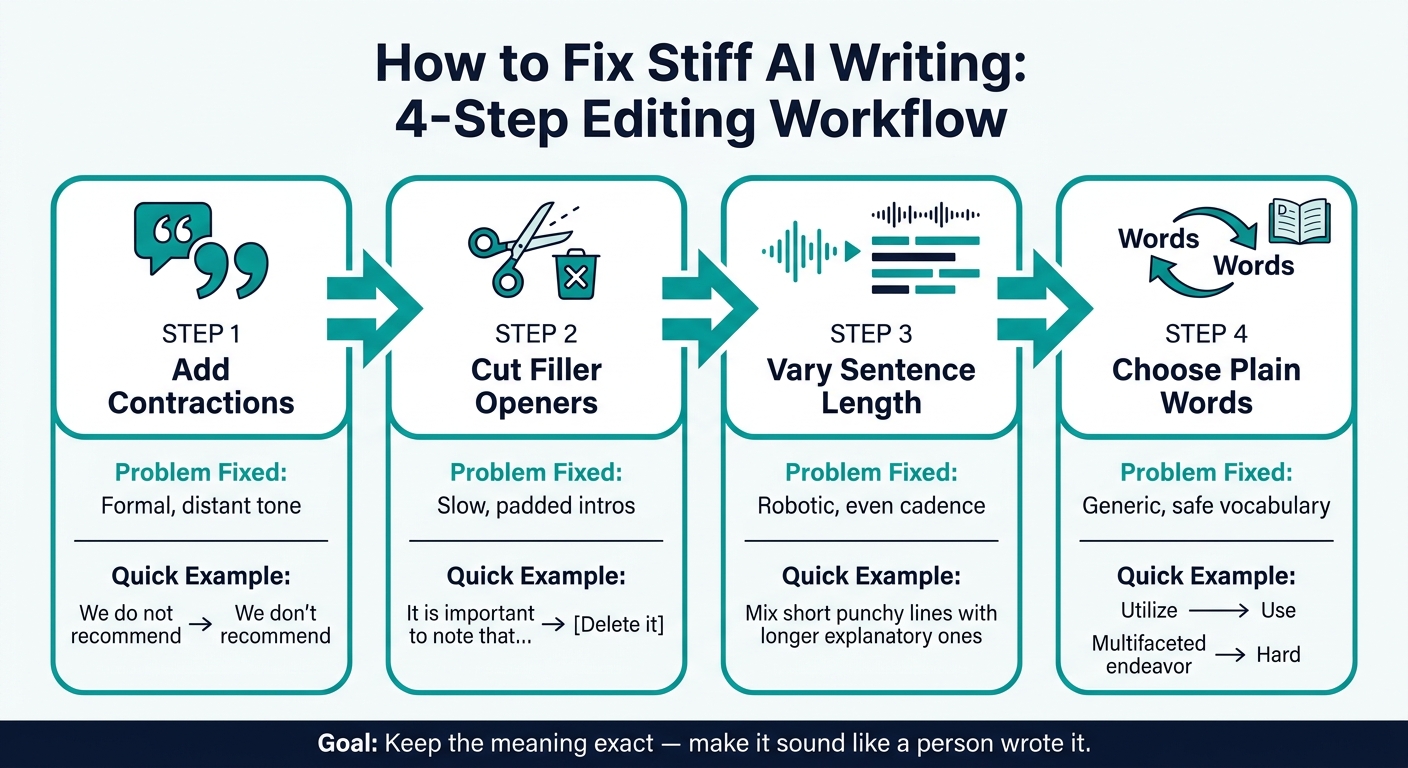
Fix AI stiffness in this order: contractions, filler openers, sentence rhythm, then word choice. Then go through the draft and apply each fix one by one.
Start by scanning for full forms like "It is", "We will", and "I am." Change them to contractions where the tone fits. After that, cut filler openers and get straight to the point. Then vary sentence length so the draft doesn't sound flat. Mix short lines with longer ones. Last, trade safe words for plain ones: use, study, hard.
If you want a faster pass, UnslopAI can automate this pass with rewrites, diffs, and fidelity checks.
Comparison table: stiff AI draft patterns vs. human-tuned fixes
The table below shows the pattern on the left and the human fix on the right.
| Pattern | Stiff AI-Polished Draft | Human-Tuned Draft |
|---|---|---|
| Contractions | "It is crucial to note that this incident..." | "This incident shows..." |
| Openers | "In today's fast-paced world, building an audience..." | "Building an audience takes real planning..." |
| Sentence length | "We will leverage automated validation to ensure gaps are identified." | "We'll use automated validation to catch these gaps before they cause problems." |
| Word choice | "I am confident my unique blend of creativity would be a valuable addition." | "I believe my creativity would make me a useful addition." |
Conclusion: Keep the meaning, drop the stiffness
Polished AI writing often sounds stiff for four steady reasons: it skips contractions, falls back on filler phrases, keeps the same rhythm from sentence to sentence, and reaches for broad, generic wording. Those habits aren't random. They're what happens when a model aims for correctness first and voice second.
The fix is pretty small, which is the nice part. You don't need to tear up the whole draft and start over. You just need to bring back the rhythm, detail, and voice that got sanded down.
"It's not about adding mistakes or making things worse - it's about making the writing feel natural again while keeping all the information intact." - Stas Leonov [1]
Keep the meaning exact. Just make it sound like a person said it.
FAQs
Why does polished AI writing still feel robotic?
Polished AI writing can still sound robotic for a simple reason: it leans on patterns people notice fast. You see full forms, careful phrasing, steady sentence rhythm, and low-risk word choice. The result is smooth copy, but it can feel stiff.
That’s usually where editors step in. They mix up the rhythm, loosen the phrasing, and swap in words people would say in normal writing - all while keeping the original meaning the same.
When should I avoid contractions?
Avoid contractions in formal writing, such as academic papers, legal documents, and professional reports, where a more authoritative, precise tone is expected.
For most blog posts, emails, and casual content, skipping contractions can make your writing feel stiff or robotic. If you want a natural, human tone, contractions usually help.
How can I make AI writing sound more natural fast?
Use UnslopAI to spot and rewrite robotic patterns in your draft fast. It helps clean up stiff phrasing, overly safe word choices, and that slightly artificial rhythm that makes writing feel off, while keeping your original meaning and voice in place.
You can use it in the web app or through the API. It also gives you a slop score and before-and-after diffs, so you can check what changed before you move on.