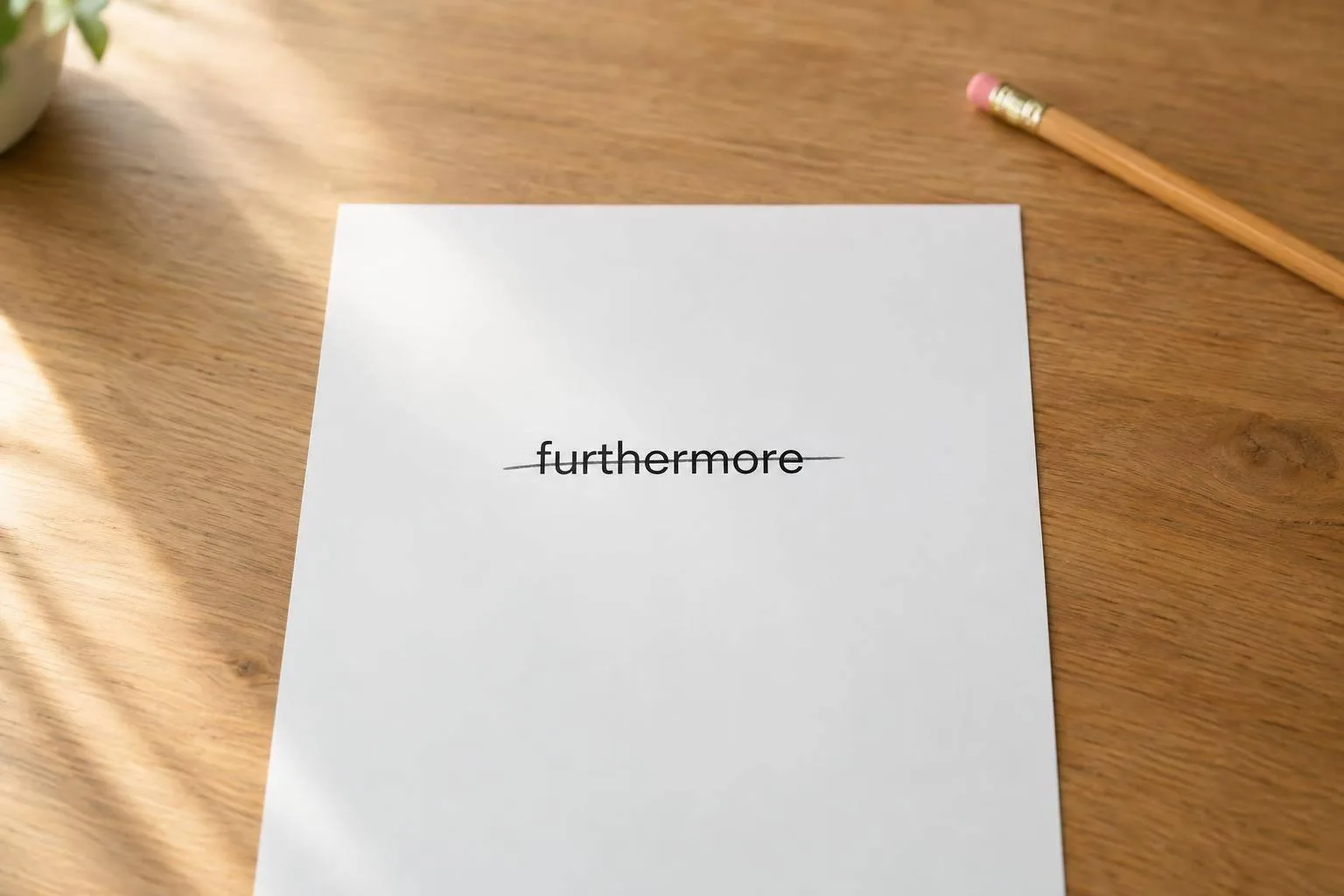
AI often overuses “furthermore” because it learns formal writing patterns - and prompts like “write professionally” can reinforce them. My first editing step: delete the connector and check whether the link between ideas still makes sense.
I use three checks:
- Keep it when it helps readers see added support.
- Cut it when the connection is already clear. Replacing it with “moreover” won’t fix repetition.
- Fix the reasoning when the ideas don’t connect. A transition can’t supply missing logic.
Repeated connectors aren’t proof of AI authorship or factual errors. Whether I edit by hand or use a tool like UnslopAI, I check facts, numbers, qualifications, and voice before accepting changes. The goal is clearer writing, not a ban on one word.
Why AI Writing Uses Formal Connectors
How Training and Prompts Shape Transitions
Language models learn transition patterns from formal writing. Prompts like “professional” or “academic” often trigger connectors such as “however,” “therefore,” and “furthermore.” These words provide signposting, helping readers follow the relationships between ideas.[1] They can also make writing sound polished - even when the logic is weak.
Treat this as a draft habit, not a rule for all AI writing.[3] Give the model a clearer instruction: use a transition only when it clarifies contrast, cause, sequence, or added evidence. Otherwise, use a direct sentence. The trouble starts when a connector sounds formal but links ideas that barely relate.
Why Connectors Cannot Fix Missing Logic
The problem is missing reasoning, not the connector itself:
The proposal will cut customer-support wait times. Furthermore, the dashboard uses a new color palette.
The color palette doesn’t explain how the proposal will cut wait times. The connector creates a visible link, but it can’t create a logical one.[2]
Before polishing the transition, ask what the design detail adds to the claim. Explain how it relates to shorter wait times, or move it elsewhere rather than using a connector to hide the gap.
The AI Writing Epidemic
When to Keep or Cut “Furthermore”
The test isn’t how formal “furthermore” sounds. It’s whether the reader needs the cue. A useful transition clarifies the connection between ideas. An unnecessary one delays the point.
Keep It When It Adds Support
Keep “furthermore” when readers might otherwise miss that the next point adds support. In a complex proposal or technical explanation, that could mean introducing a separate safety benefit after a performance benefit. Don’t cut the word just to make the tone less formal. If it helps readers follow the connection, it earns its place.
Cut It When the Connection Is Clear
Remove “furthermore” when the structure already shows the link or when several paragraphs use the same kind of opening. Swapping it for “moreover” or “additionally” changes the word, not the pattern. If the second point doesn’t support the first, cut the point - not just the transition.
Use these quick tests to see whether the transition helps or just adds words.
-
Keep it for a separate supporting benefit in a hypothetical proposal.
“The pilot reduces call wait times. Furthermore, it gives supervisors real-time queue data.”
-
Use “also” or drop the transition in a hypothetical email.
Original: “The vendor missed the deadline. Furthermore, the invoice was incorrect.”
Revision: “The vendor missed the deadline. The invoice was also incorrect.”
-
Cut repeated openings in a hypothetical proposal.
Original: “Furthermore, the system encrypts files. Furthermore, it limits access by role.”
Revision: “The system encrypts files and limits access by role.”
-
Remove it when it adds nothing.
Original: “Furthermore, the team is available for a follow-up call.”
Revision: “The team is available for a follow-up call.”
How to Edit Repeated Transitions
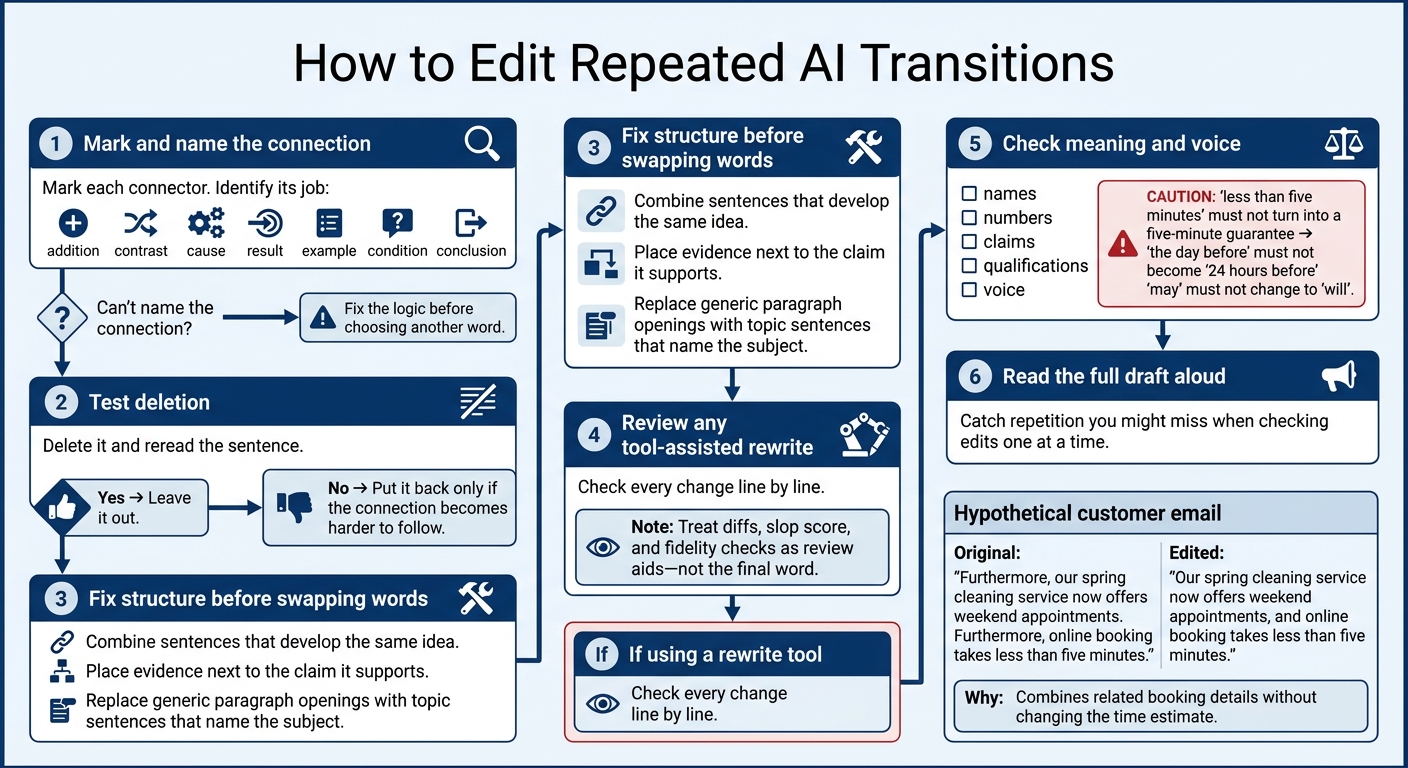
When you spot repeated transitions, edit the sentence structure first. Swapping one connector for another won’t fix a weak connection.
Name the Connection and Test Deletion
Mark each connector and name its job: addition, contrast, cause, result, example, condition, or conclusion. Then delete it and reread the sentence. If the meaning stays clear, leave it out. Put it back only if the connection becomes harder to follow.
Can’t name the connection? Fix the logic before choosing another word.
Fix Structure Before Swapping Words
Combine sentences that develop the same idea. Place evidence next to the claim it supports, and replace generic paragraph openings with topic sentences that name the subject.
In the hypothetical cleaning-service email below, group the appointment options together and keep the booking detail nearby. The goal is to rewrite the logic, not just the opener.
Hypothetical customer email: editing decisions
Original draft Edited draft Why it changes Furthermore, our spring cleaning service now offers weekend appointments. Furthermore, online booking takes less than five minutes. Our spring cleaning service now offers weekend appointments, and online booking takes less than five minutes. Combines related booking details without changing the time estimate.
Check UnslopAI Edits for Meaning and Voice
If you use a rewrite tool, check every change line by line. UnslopAI can rewrite AI-polished drafts while preserving meaning. Treat its diffs, slop score, and fidelity checks as review aids - not the final word. Use the web app for one-off drafts or API/MCP access for repeat workflows.
Compare each rewrite with the original for names, numbers, claims, qualifications, and voice. In the email above, “less than five minutes” must not turn into a five-minute guarantee. A reminder “the day before” must not become “24 hours before.” Check that “may” hasn’t changed to “will” and that the tone still sounds like your business.
Then read the full email aloud to catch repetition you might miss when checking edits one at a time.
Conclusion: Keep Transitions That Help Readers
AI often overuses “furthermore” because style patterns can outrun logic.[5] Fix the logic first, then the wording. A paragraph can look organized without making a strong argument. A connector names a relationship; it doesn’t supply missing evidence.
Swapping “furthermore” for “moreover” changes the wording - not the reasoning.
Identify the relationship, then try deleting the transition. Keep it only if removing it weakens the meaning or emphasis.[4] Use “furthermore” when it helps readers follow added support, not when it just makes an obvious connection sound formal.[6]
FAQs
How can I prompt AI to use fewer formal transitions?
Give AI a clear voice profile: direct phrasing, everyday words, and a conversational rhythm. Rather than saying “keep my voice,” set limits on stock transitions like “furthermore” and inflated language.
Already have an AI draft? UnslopAI can rewrite it to sound more human without changing your meaning. Before-and-after diffs show where it removed filler transitions.
How many transitions are too many in a paragraph?
There’s no magic number. A paragraph has too many transitions when they make the rhythm feel repetitive or scripted rather than natural.
Try removing a transition such as “furthermore” or “on the other hand.” If the meaning stays clear and the ideas still connect, cut it. Keep transitions only when they help readers follow the connection.
How can I cut transitions without losing flow?
Start by cutting transitions you don’t need. If the surrounding sentences already make the connection or contrast clear, skip the bridge phrase. When a connector helps, use plain words like but, yet, or and instead of formal options like furthermore.
UnslopAI can also rewrite stiff transitions while keeping your meaning and rhythm intact. If a sentence works without a transition, leave it out.